World War 2 started in September 1939, but there was a lot that happened ‘before the beginning’. War had been a threat since the early 1930s, so on this page I’ll look at the preparations which happened in those years from the mid 1930s up to September 1939.

Guiding in the 1930s
Guiding in the 1930s was widespread across the UK. This was partly influenced by the social situation which had existed in the 1920s. During the early decades of the 20th century, Leaders in Guiding were expected to be from the upper or upper-middle classes – and at that time, girls and young women of the upper and upper-middle classes did not normally enter paid employment of any sort – instead they were ladies of leisure until such time as they were married, at which point they would keep house and raise the children. As ‘ladies of leisure’, their free time was spent in doing ‘good works’ for charities in the local community, such as Guiding. But the 1st World War, and the influenza pandemic which followed it, meant that hundreds of thousands of young men had been killed, particularly young army officers from the upper middle and upper classes, and as a result there weren’t enough unmarried young men to go round. The direct result was that many thousands of young women who might otherwise have been married were left as widows or spinsters, and in the absence of opportunities for marriage their leisure years lasted far longer than would normally have been the case. Many of them became active in the community, including as Guiders.
Guiding had also spread internationally through the 1920s and 1930s – but in 1933 there were some reverses – in Italy all youth organisations were closed by the government and replaced with by the compulsory-membership Balilla – and in Germany, Scouting and Guiding were banned and replaced by the Hitler Youth and the equivalent for girls, the Bund Deutscher Madel or BDM.

The World Centres
The first ‘World Centre’ for Guiding, Our Chalet, opened in Switzerland in 1932. It had been a long-held dream to have a centre which belonged to everyone in Guiding rather than any particular country, and which all could visit and find world friendship and fellowship. But it took many years for the dream to come to fruition, as well as a generous donation from an American benefactress.
The second World Centre, Our Ark, opened in March 1939, with the formal opening being on 2nd May, in a ceremony attended by Guides from Switzerland, Sweden, Poland, India, Luxembourg, Norway, Hungary, South Africa, England, Ireland and Scotland, along with many members of the World Committee. It was intended to meet the demand for an international hostel in London for the many Guides from around the world who visited the UK each year to visit the home of Guiding.
1938 and ‘the piece of paper’
By the late 1930s, the situation in central Europe was becoming more tense. In “The Guider” in March 1936 the following appeared on the letters page:
“Dear Editor – I should be very glad to hear the views of some of my fellow Guiders with regard to the question of being trained in case of war. Whilst every thinking person must ardently desire and pray for peace, yet I wonder whether one ought not to live up to the motto and “Be Prepared”. The desire for pacifism has definitely led us into a state of unpreparedness in case of emergency. We have done our utmost to set an example, but the world being as it is, this example has not been followed. Now, the query presents itself to my mind, does the preparation to meet an emergency give birth to thoughts which otherwise might not have matured? Is it possible, that in facing up to a possiblility, we actually start up ideas on war and armaments, which we are most anxious to crush? Can there be people who having organised defences, are desirous of seeing how they really work? I feel that training of all kinds is beneficial, that we should be fit, morally and physically, to meet any emergency. Is this a safe policy to teach my Guides? Shall I be accused of being militarist? I should much like to hear the views of my fellow Guiders. Yours, etc, ‘One Who Is Puzzled’.”
In the spring of 1938 the “Challenge to Achievement” was launched in “The Guide” magazine. This was a challenge for Patrols, to earn the right to be termed a ‘Beaver Patrol’. There were four tests, based around Patrol Turnout, Individual Practice, Patrol Sealed Orders, and a Final Beaver Test. For the first test, the Patrol were challenged to regularly be attired in smart, matching uniform, and submit a photograph, signed by their Guider, to confirm that it was representative of their regular appearance at Guide meetings. The Individual Practice tests were issued to Patrol members in sealed envelopes and included tests of agility and of practical observation, such as climbing a tree, crossing a stream on a plank, knowing the doctor’s car by sight at a distance and memorising it’s number, learning to forecast the weather by signs, etc, and of self-discipline such as walking without stopping for rest or refreshment, or taking up a personal challenge for each of the Guide Laws. The challenge culminated in a special Beaver Camp for Patrols who had successfully passed all the challenges, held in Yorkshire in August 1939.
Political tensions had been growing in many countries around Europe throughout the 1930s, and concern was growing even in Guiding circles about how best to handle this. During 1938 “The Guide” magazine even started a monthly current events page, “What Is Happening In The World” to give an outline for Rangers of what was happening politically between the various nations of Europe, and give the viewpoints of the different political parties (or factions within them) on recent events, and the implications resulting. War was narrowly averted in September 1938, when the British Prime Minister, Neville Chamberlain, reached an agreement with the German Fuhrer, Adolf Hitler, and brought home the signed ‘piece of paper’.
There was, however, still general concern. In “The Guide” magazine in December 1938, the Commissioner for Rangers wrote: “A troubled New Year. Anxiety, horror, insecurity, starvation, destitution, death, fear, chasing each other as storm clouds pass across the world. We Rangers will have faced by now, each our own individual crisis. We shall have decided, what it is each one of us is called on to do in the service of our country. The decision will bring with it a measure of peace.”
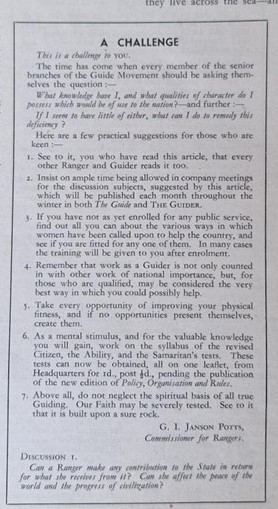
A Challenge To Rangers was also issued: “The time has come when every member of the senior branches of the Guide Movement should be asking themselves the question ‘What knowledge have I, and what qualities of character do I possess which owld be of sue to the nation, and further, If I seem to have little of either, what can I do to remedy the deficiency?’ Here are a few practical suggestions for those who are keen:
1) See to it, you who have read this article, that every other Ranger and Guider reads it too.
2) Insist on ample time being allowed in Company meetings for the discussion subjects, suggested by this article, which will be published each month throughout the winter in both The Guide and The Guider.
3) If you have not as yet enrolled for any public service, find out all you can about the various ways in which women have been called upon to help the country, and see if you are fitted for any one of them. In many cases the training will be given to you after enrolment.
4) Remember that work as a Guider is not only counted in with other work of national importance, but for those who are qualified, may be considered the very best way in which you could possibly help.
5) Take every opportunity of improving your physical fitness, and if no opportunities present themselves, create them.
6) As a mental stimulus, and for the valuable knowledge you will gain, work on the syllabus of the revised Citizen, Ability and Samaritan’s test.
7) Above all, do not neglect the spiritual basis of all true Guiding. Our faith may be severely tested. See to it that it is built upon a sure rock.”
It also read “Ever since the crisis last September we have all been feeling the need of doing something to help towards the well-being of our country and the peace of the world. If we want to help out country we must first of all know what she is and what she stands for. We must learn what social conditions are to-day, and where they need improvement. We must learn both what is and what might be, and how to turn the first into the last. Here is a chance for Rangers as well as Guiders. Here is a challenge – and here are definite suggestions as to how to meet it. If every Ranger and Guider will determine to learn the main principles of citizenship, will discuss it with her fellow Rangers and Guiders, according to the suggestions made in this issue of The Guider, she cannot fail to discover ways in which she may satisfy her desire for service. The world’s great reforms have been made by quite ordinary men and women, who have banded together in a common cause. What cannot the Guide Movement do, if united, to help in the fight against dirt and disease, to mention only two of our present evils? But we must get more and more people into our ranks – we must put every ounce of strength into our work – we must have a living faith in our ideals. We can acquire the faith which moves mountains. So set to work at once on the first problem set before you, and as you study this, you will find yourself gradually acting as well as thinking.”
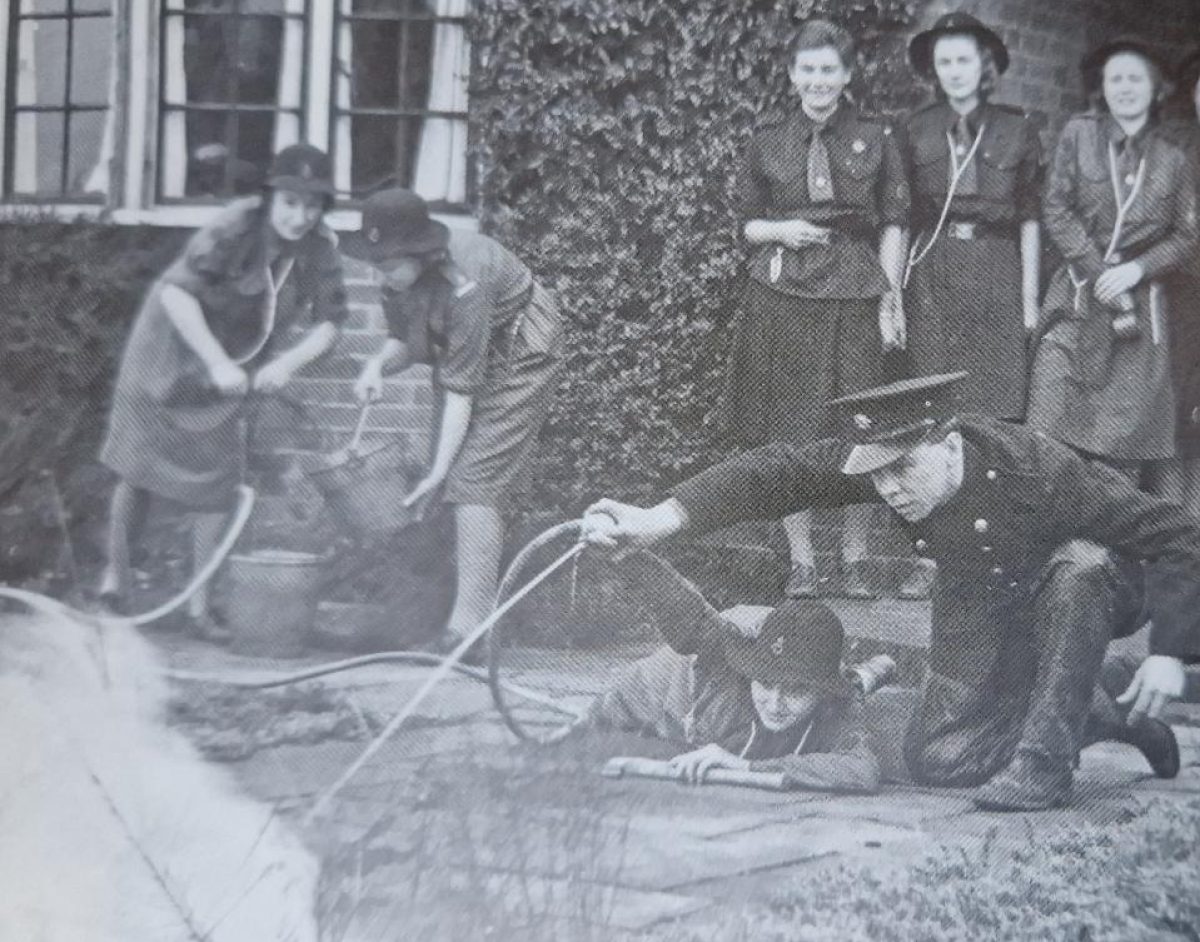
With the risk of war, and memories of poison gas being used on the battlefield during WW1, across Britain gas masks were issued to all civilians, and Guides were involved in the assembly and distribution of them, whilst seeking to reassure anxious parents and frightened children alike. Older Guides and Rangers volunteered for ARP work, and some of their camp equipment was commandeered for military use.
One Ranger unit had their latrine tents commandeered for use as decontamination cubicles, and they were trained in how to do the contamination work. As practice, they dressed in overalls, gloves, wellingtons and gas masks. When volunteer casualties entered the tent, the Rangers had to instruct them to strip off their clothes, then the Rangers would use the bucket of fluid and large distemper brush to paint them from head to foot with the fluid. For practice purposes whitewash was used as the pretend decontamination fluid – though their first ‘casualty’, the local Curate, opted to leave his underpants on, the Rangers were nevertheless thoroughly embarrassed to see him sans trousers!
Rangers in country areas were encouraged to consider agriculture, as a form of National Service which they could take on using their prior countryside knowledge, staring with a focus on the agricultural badges, but also considering the work being undertaken at the time to recruit the Women’s Land Army, to enable more land to be cultivated and more animals tended to increase the food supply within the UK, especially with the risk of many of the young men working in agriculture being called up to the defence forces.

The Pax Ting
The latest World Camp, the Pax Ting, was held in Godollo, Hungary, in July 1939. The Guides in Hungary had been planning for it for several years, planning programmes and outings, and learning foreign languages ready to serve as interpreters for their visitors. Despite the growing international tensions across central Europe it was decided to proceed with the camp. But – some countries took their own precautions – the Polish contingent altered their original group, replacing all the younger girls with handpicked Rangers who were experienced in mountain hiking and equipped with special maps, in case war should break out and they should have to find their own way home overland surreptitiously.
The UK party of 200 handpicked Guides for the Pax Ting, led by 24-year-old Alison Duke, Captain of 1st Cambridge Guides, set off by train from London at 3pm on 23rd July, crossed the channel by steamer, then caught a special train from Ostende to Godollo. When they reached the German border at Aachen, a group from the Bund Deutscher Madel were waiting on the platform to greet them, and one of the leaders from the Bund travelled onwards to Cologne with them, to help with arrangements. There was a further welcome at Cologne, despite it being 4am, with girls from the Bund singing songs, handing over flowers, and taking the British group to breakfast. The train reached Godollo at 5am on July 25th. The Hungarian Guides were there to meet the group. For the next two days, more Guides arrived from all over Europe, with the first ceremony held on the 27th, including a full parade of all nationalities, each country marching through it’s sub-camp gate carrying it’s colours and forming up round the flagstaff while the Hungarian flag was raised. On the 28th there was a wreath laying ceremony at the tomb of the Unknown Soldier in Budapest, including a wreath of poppies from the British Guides – after this the British Guides visited the City museum, and then undertook a sightseeing tour of Budapest. The official opening ceremony of the camp was held on July 30th, with a number of distinguished guests. During the fortnight-long camp there were trips to Pruszta, and to Estergom by river steamer, there were giant campfires and international exchanges and friendships. Over 5800 Guides from 32 countries attended the ‘Parliament of Peace’ themed camp.

Volunteers wanted for war service
Meantime, throughout late 1938 and the first half of 1939, “The Guider” published regular articles looking at preparation in case of conflict. From offering discussion topics for Ranger Companies on whether there should be compulsory National Service, or why countries go to war – to looking at careers for women such as ATS, WRNS or Nursing – to considering topics such as training for leadership. In September 1938’s “The Guider” , and in subsequent issues, were published a range of suggested options for National Service for Rangers and Guiders to consider.
In early 1939, London Sea Rangers offered their help to the Thames Ambulance Service. At that time the Thames Ambulance Service were adapting small pleasure steamers to be able to carry around 120 casualties each, from areas which might well be affected by air raids on to piers downriver away from likely bombsites, where they could be transferred back onto ambulances and taken to hospital. It was planned that each boat would have two medical units, one on duty and one resting at a time, and each unit would include two London Sea Rangers with Red Cross or St John Ambulance certificates and Air Raid Precautions training, who would help with patients in the small launches when the tide didn’t allow access for the pleasure steamers, as well as carrying out signalling, catering and other support duties.


‘these skills will be useful whether war comes or not’
In the September 1939 issue of “The Guider”, published shortly before war was announced, appeared the following text:
“Be Prepared
At the moment of going to Press we are waiting for news which must affect all civilisation. Now, more than ever before in the History of Guiding we need to hold steady and face facts.
With our motto of “Be Prepared” we cannot blind our eyes to what is going on in Europe. Because we are an international Movement we deplore, more perhaps than other people, the thought of War. But if we refuse to admit the possibility that war may occur, we are behaving like ostriches, not Guiders.
We must hold fast in our determination to establish ourselves firmly, so that we are ready to meet whatever the future holds in store. In order to do this sanely, we must know quite clearly what are our ideals, what we believe is right, and how we stand in relation to the rest of humanity.
We must hold fast to the belief that good must triumph, that the forces of right are stronger than the disruptive force of evil which is trying to shatter all that which has been built up in the last quarter of a century. We must cling to that belief. But at the same time, let us be ready to put ourselves, calmly and cheerfully, at the service of the community should the worst happen.
We are a great Movement, and we boast a strong motto. We should be able to provide a useful force of trained, reliable workers throughout the country at a moment’s notice. Do you consider that is true of your company? Could your Rangers and Guides take the field of service calmly and methodically? I know of an Eastbourne Division which has taken over and staffed two empty houses in preparation for evacuated children – should war break out. Are you prepared in a similar way? Or have you other good ideas? If so, do please let us know! We at Headquarters are intensely interested, and we would like to let Guides all over the country know what is going on in the Movement in other localities.
In the beginning of 1938 The Guider gave as its watchword “Be strong and of a good courage.” It gives you that watchword again now, whether the event be Peace or War. But in the meantime, until the very last hope of a peaceful settlement has gone, each one of us, by her own faith can help to strengthen the armies of Peace.
Remember in September last year we hardly dared to hope for another summer of Peace. A year has gone by, a year which has held the Pax-Ting, and other international gatherings, a year in which despite threatening war clouds, we have still gone abroad and made friends in other countries – friends we will never forget, who have laughed with us, who have shared our hopes and striven towards the same ends.
That has happened since September 1938. If we can hold steady – we may look back in September 1940, on another year of such happenings – but each one of us must do her share. We must go forward guided by the light of our own faith, knowing that, even should we fail this time to achieve that state for which we are all praying – even then there must be an afterwards.
The Great War taught humanity much, but there is still much to learn, and those who come after will profit by our mistakes as well as our achievements.
During the next critical weeks, we as Guiders must keep steady if we are to keep our Guides steady. We must keep cheerful, not with a false cheerfulness of hysteria, but with the quiet reassurance which comes from an inner courage, an inner strength. Only thus can we preserve for those who follow us something of good, something of sanity, something on which they may build.”
In September 1939, one other piece of preparation was made as war threatened. As “The Guide” said, “This week there is no news-reel column for you. Only the photograph of our great Founder’s portrait, which in normal times hangs in the Council Chamber of Imperial Headquarters. When, on Friday September 1st, we were told that war was imminent, we took down that portrait, because it is one of our Movement’s most precious possessions, and put it away in safety in the Strong Room in the basement. One day (and let us pray it may not be far away) we shall be able to hang it again where it belongs. But until this war, which no one wanted but which everyone is prepared to fight to the last in the cause of reason and common-sense, of honesty and freedom, ends, keep the picture before you . Remember, you are trusted on your honour and with every single one of you rests our honour, the honour of Guiding, built up through the years. You won’t fail. You will be brave, and cheery, and useful, just as the Guides who first won the respect of older citizens in the war of 1914-1918 were.”
 Leslie's Guide War History