
Guiding in September 1939
By September 1939, Guiding was a mainstream hobby, popular across the UK and with all classes – helped by the fact that both Princess Elizabeth and Princess Margaret had joined the movement a few years before. The Guide uniform had recently changed from navy blue to the lighter shade of ‘headquarters blue’, and badges and programmes had been regularly modernised to appeal to members. In addition, schemes such as the ‘Beaver Patrol’ scheme in 1938 had encouraged Guides to brush up on their key Guiding skills, and on relevant proficiency badges such as first aid, child nurse, backwoodsman, interpreter and cook, which would be useful whether war broke out or not.

Pre-War Exiled Guides
Although it was in September 1939 that war threatened the UK, by then it had already affected many countries in Europe. During the 1930s the pressure had grown in many parts of Europe, especially against Jewish people. Prior to November 1938, individual Jewish people could move to Britain if they were ‘sponsored’ by someone already resident there, but not otherwise. Following the violent events against Jewish people on 9th November 1938, which became known as ‘Kristallnacht’, the UK Home Office announced that they would allow access to all European Jewish children who were sponsored (but not adults). Following this, regular ‘Kindertransport’ shipments followed, with families opting to send their children away in hopes they would be safer in Britain. Many of the girls who arrived in Britain through Kindertransport became part of their local communities, and joined Guiding.

War is declared
The people of Britain knew that their Prime Minister was due to broadcast to the nation by radio on Sunday 3rd September 1939, at 11.15 am. But – broadcast what message? Across the UK, families gathered round radios to hear what he would say – had peace been negotiated at the last minute, or as many feared, was war to be declared? An ultimatum had been delivered to the German Chancellor with a deadline of 11am. The broadcast began, and after a preamble, Prime Minister Neville Chamberlain advised, “this country is at war with Germany.”
As “The Guide” magazine stated “many of you are on your way out of the big towns, heading for unknown destinations. This morning, on the way to Headquarters, we saw you going off, cheery and determined, with your worldly possessions slung all round you, looking the good adventurers you are. By now, some of you will be settled in the country who have never lived there before. That is going to be exciting for you – and you are lucky, because there are still long weeks of autumn ahead of you.” “Perhaps you will only be away a little while, when you read this, you will be home again. We hope so, because it will mean a miracle has happened, and at the eleventh hour, war has still been averted. No one wants war. Don’t forget that, will you? People may lose their sense of proportion and blame the citizens of other countries for what the leaders have done, but there is no sense in doing that. Hatred and bitterness help no one – you may have quite a lot to put up with, but getting all worked up against people exactly like yourself, who also love their homes and families and enjoy a quiet life when they can get it, is just waste of time. If war comes many of you will be without Guiders, because your Guiders will be on active service. Well – that happened to lots of us between 1914 and 1918. It’s a chance to show what you are made of, and what the Company means to you. Set to work with determination and keep going. If you are reduced to a single Patrol, one small Patrol, if it is up to standard, can be of use to a whole district. Those of you who are scattered, right away from other Guides, remember the grand tradition of the Wandering Lones. Keep in touch with the Movement through this paper, wear your badges, and stand by for whatever adventures come your way. You may be one by yourself, now, but you are one of a million – never forget that!”
As The Guider magazine put it “The tragedy we have all tried to avert, by deed, thought and prayer, has come upon us. Perhaps, fortunately, we are all too busy to think very much nowadays, for if we had time to think we might be weakened by the very horror of it all. We might become angry, and anger is a thing which is better kept out of this war, because it leads to hatred, and hatred breeds injustice and cruelty.”

Call-up – the Guiders depart on War Service
War was declared on 3rd September 1939. Immediately, following the radio announcement of the war declaration itself, were instructions for those among the many adults who had already registered for war service, advising them to immediately report for service according to the instructions on their calling-up papers – and as Guiders had been heavily encouraged to volunteer for war service, so many Guiders were among those who were called up in the first few days of war.
At Guide Headquarters, many of the staff left to take up senior positions in the forces, but it also affected Commissioners and Guiders at local levels. As well as those away serving in the forces, were those required in professions such as nursing – there was a belief that as soon as war was declared bombing attacks were likely, and it was feared that this could lead to mass casualties. Call-up could be to the women’s branch of the army, the Auxiliary Territorial Service (ATS), to the Women’s Royal Air Force (WRAF), to the Women’s Royal Naval Service (WRENS), to work for the NAAFI in their canteens and other services supporting the forces, or join the FANY – the First Aid Nursing Yeomanry. Over 1000 Sea Rangers joined the WRENS. Other Guiding members were called up as ambulance drivers, Air-Raid Wardens, nurses, factory workers or farmhands.

Evacuation – leaving the cities
When war was declared, Operation Pied Piper, the plan for evacuating children from cities, was put into action. Children reported to their schools and gathered in the playground in class groups, a small suitcase in hand, and a luggage label attached to their coats giving their name and home address. Their teachers marched them from there to local railway stations, or onto packed buses, from which they departed to destinations unknown in the country. Only younger children were accompanied by a parent. Most of the younger children didn’t fully grasp what was happening or what it might mean in terms of how long they might be away or what might happen at home if war broke out – but the older children did. On arrival at the ‘destination unknown’ many children were taken to village halls, and then allocated to each house which was deemed to have capacity. The plan was that they would then live there ‘for the duration’. Country residents were not given any choice over whether they took in evacuees – before war was declared, local billeting officers had surveyed the area and decided how many evacuees each house could accept, they were then allocated that number – compulsorily.

Evacuation – influx from the cities
Just as evacuation meant most of the Brownies and younger Guides leaving the cities, so it also meant large numbers of them suddenly arriving in the country. Guide companies in ‘reception’ areas were urged to enlarge in order to take in any Guide evacuated to their area, and any country Guider who could spare any time was asked to offer help. Villages saw dozens of children arrive, most of whom had never been to the country or seen farm animals before, all of whom were scared, some still ill from travelling, finding themselves in strange houses with strange people and no idea when or if they might ever return home – or if there would be a home or parents to return to. And country people, some unused to dealing with children at all far less living full-time with them in the house, were suddenly faced with housing and looking after the unfamiliar children, some of whom were from deprived areas and unused to having a bed each, or regular washing, and had no idea of country lore or unwritten rules. All the families had been given a list of things they were meant to pack in the suitcase each child was to take with them during evacuation – a change of underclothing, night clothes, house shoes or plimsolls, spare stockings or socks, a toothbrush, comb, towel, soap, facecloth, handkerchiefs, and if possible a warm coat or mackintosh. That list may seem minimal for a stay of unknown duration, but for those from poorer areas it was nevertheless impossible to supply – many families did not own a suitcase, nor half the clothes requested – many children had few more clothes than they stood up in, and shared facecloths and towels with all of their family. In all, over 1.8 million children were evacuated to the country.

Patrol Leaders in Charge
In country and city areas alike, the Patrol Leaders often found themselves left to keep things running. In city areas, all of the schoolchildren were evacuated, leaving only the over-14 Guides who had started employment. So Brownie units were closed, and Guide units either struggled on, or in some cases merged, to get viable numbers.
In the country, Patrol Leaders in small units found themselves with large numbers of transfers wanting to join – and also taking on responsibility for local Brownie units, in the absence of their Brownie Guiders. Those Brownie units could grow from fewer than a dozen, to over 50. Many PLs found themselves helping to introduce evacuees to the country – with schooling often being half days as country schools were overwhelmed with the numbers of children, so the evacuees had time to be introduced to the country and have the customs regarding closing gates, walking round field margins, being allowed to pick hedgerow fruit – explained to them.
All units were affected by the blackout and by meeting halls being taken over by the authorities – with many halls taken over by Local Defence Volunteers, Civil Defence, and Air Raid Precautions Wardens, as well as blackout rules, meaning that meetings often had to be held at weekends instead.

Early Guide War Service
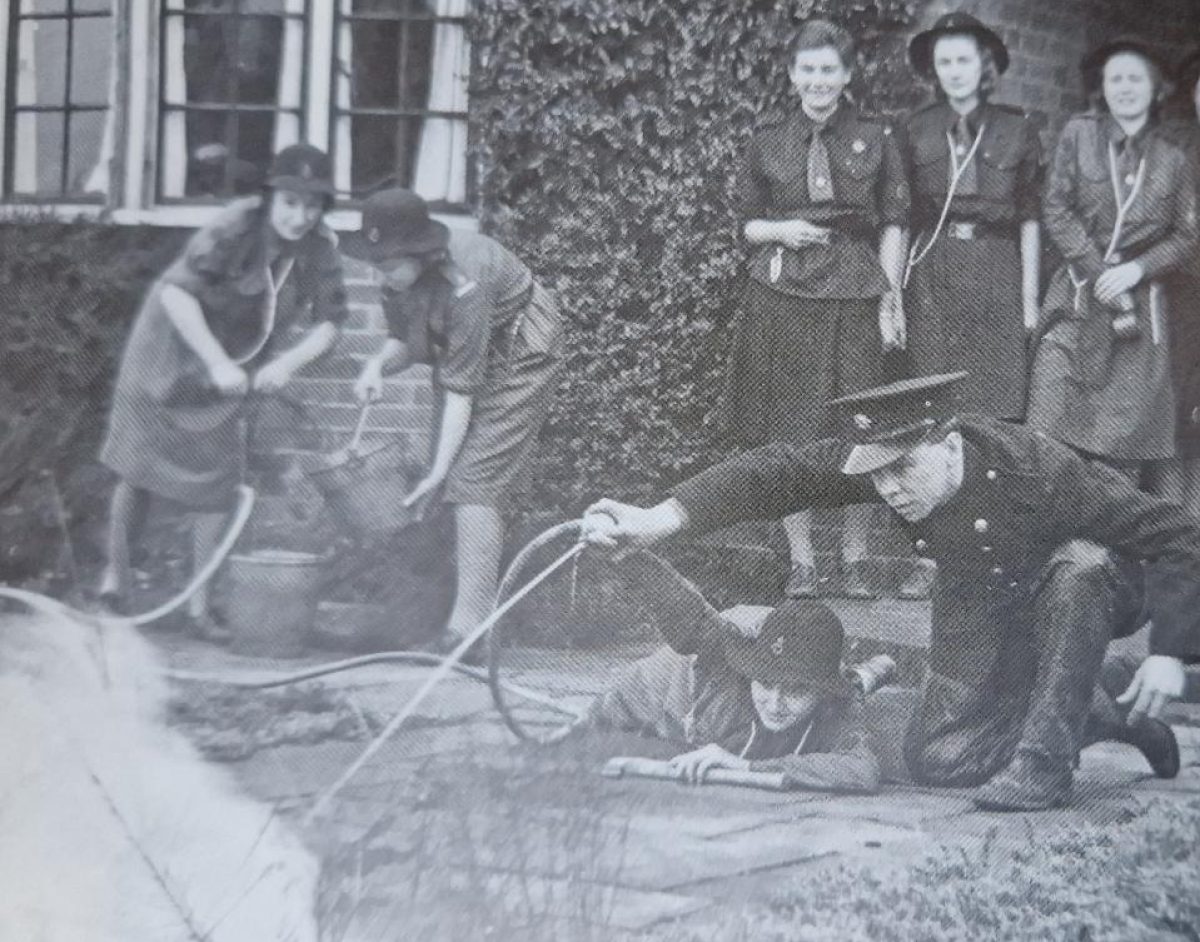
From the very earliest days of the war the Guides were busy, and many stories were shared. Evacuation meant preparing not just homes for evacuated children, but also hostels for incoming workers. In many areas Guides were involved in preparing empty buildings to be hostels by scrubbing out the buildings, carrying out repairs, and sourcing furniture and equipment. At the same time, the contribution the Guides were making was being recognised: “The Guides were marvellous in the raid alarm yesterday morning. We all had to go down to the shelter, and some were a bit flustered. But the Guides had them singing camp fire songs, men and all, in less than no time – the morale of the Guides is just fine.” In several localities Guides formed a messenger service, sometimes by themselves, sometimes together with other youth organisations.
In November 1939, The Guider published a “Suggested Scheme of Work for Training Guides for National Service”.
“In order to be able to help, according to her circumstances, a Guide should be able:-
To prepare and cook vegetables. Make tea, coffee and cocoa. Wash up. Wash and iron cotton and woollen garments. Darn, patch and sew on buttons. Should know at least three occupations which would be possible for keeping children of 4-8 years of age interested or less frightened during an Air Raid, and be able to tell a story to children of the same age. Should be able to carry verbal messages, and to report either verbally or in writing any importance occurrence which she has witnessed. Be able to send a message from a public telephone box and use an ordinary dial telephone. Have a special knowledge of the locality in which she is likely to serve, with particular reference to A.R.P. stations, Casualty Clearing Stations, Gas Proof Shelters, Hospitals, Evacuation and other rallying posts, Wardens’ Posts, Telegraph office, Telephone boxes and Doctors. Have a practical knowledge of the fitting and care of civilian gas masks. Know the dangers of panic in an emergency, and be so trained that she will be likely to help on the right lines should the necessity arise. Have practised activities and the finding of her way about buildings in the dark, to give her assurance and enable her to help in the case of need.”

Early Brownie War Service
During the early days of the war, much of the Brownie service was in practical handicrafts – knitting string into dishcloths, and scrap wool into blankets. With so many adults working long hours, and also doing extra work such as being ARP wardens or Fire Watchers, Brownies found themselves doing more around the house to help, and having to be more independent, sometimes also looking after younger siblings.

Extension Guides at War
Extension Guides was the term for Guides with disabilities in this era, as Guiding was ‘extended’ to them. Wartime was an especial issue for those with physical disabilities, as many didn’t attend school, and so weren’t included in the government evacuation plans. It meant that girls who were housebound had to stay at home unless their families could make their own arrangements for them to stay with friends or relatives in the country – so the majority remained at home. For some who were housebound or bedbound, going to an air raid shelter wasn’t an option – they had to stay in the house and take their chances on whether the house would be bombed or not.
Woodlarks campsite was a specialist Guide campsite for disabled girls – with the coming of war it was occupied by girls aged from 16 to 28, evacuated from London.
In Scotland, the Trefoil School was set up near Edinburgh, as a residential school for children with physical disabilities, staffed by Guiders – it continued to operate until 1976, with the building becoming an adapted holiday venue for people with physical disabilities thereafter.

The Training Centres
Foxlease’s arrivals on Friday 1st September weren’t the Guiders who had been due to attend there to be trained, but instead 16 boys from a school in Portsmouth, along with their younger brothers and sisters, three schoolmasters, and four Mothers. After a short stay they were off to billets in Copythorne. Throughout the war, Foxlease continued in use offering a range of training weeks in the main house. At the same time, some of the cottages were offered for Guiders to book short breaks, as respite in the country, at a time when life in the cities was difficult.
Meantime Waddow Hall was transformed – the Ranger training finished on August 30th, and by September 7th Waddow had been adapted and handed over to Lancashire County Council as a fully-functioning children’s emergency hospital for ill evacuated children. It continued to serve in that role right through to the end of the war, before it was returned to the Guide Association to resume it’s former role as a training centre.

Polish Guides at war
Polish Guiding was founded in 1910 by Olga Malkowski, shortly after she had married the founder of Polish Scouting, Andrzej. Andrzej was killed fighting with the Polish army in 1919, following which Olga focussed on leading Guiding in Poland. From 1938 the Polish Guides began preparing against the threat of war. As the Pax Ting approached, with the threat of war ever rising, the membership of the Polish party to attend it was altered, swapping out the younger Guides for more experienced Rangers who, if necessary, could make their own way back over the mountains from Hungary if war should break out during or immediately after the camp.
Although war held off until after the Pax Ting, on 1st September 1939 Poland was invaded. Most of the Guides immediately joined the underground ‘home army’ resistance, and became known as the ‘Szare Szeregi’ or grey ranks after their grey Guide uniforms. They worked in communications and first aid, looked after orphaned children, and used their stalking skills to carry messages and food to resistance workers in remote locations. By 23rd September Poland was defeated, Guiding was banned, and anyone identified as being a Guide was being arrested. Nevertheless, secret Guide meetings, and work for the resistance, continued, including running soup kitchens and hiding Jewish children. Meantime, Olga Malkowska escaped to Britain, finally arriving there a month later.

“Save All Supplies”
Rationing in Guiding started early – indeed, in early October “The Guide” magazine received warning from the printers that they would immediately be required to halve the number of pages in the magazine, which had previously consisted of 8 sheets of paper plus a cover. (Before long, the weekly magazine would be reduced to only eight pages most weeks – two large sheets of paper, held together by a single staple instead of two).
With memories of shortages experienced during WW1, in December 1939 Guiding launched their “Save All Supplies” campaign – before the Government had started on any such scheme. It was clear that on an island like Great Britain, with industry focused on producing goods for the war efforts, and the likelihood of attacks on merchant shipping stopping Britain from receiving the steady supply of food imports she was so reliant on, action was needed to ensure that all supplies which were currently in the country should be used to best advantage, that food supplies should be maximised by cultivating as much ground as possible into vegetable patches, small-scale farming of chickens, rabbits or pigs be increased, and that money should be raised to support the forces through the collection of waste goods which could then be sold to raise funds. So the aim of the scheme was “1) To increase supplies by conserving useful material which is usually wasted. 2) To increase food supplies. 3) To raise money for hospital supplies, and garments for the fighting forces.”
Suggested projects were:
Supplies – collect and put to best use, bottles, jam jars, old iron, tins, rags, used postage stamps, old and broken gramophone records. Help with waste paper collection. Collect eggs for the National Egg Collection for Hospitals. Collect tinfoil and silver paper for the Red Cross and St John’s Ambulance.
Food Supplies – as a Patrol or unit, undertake to cultivate a patch of land for vegetables, keep rabbits, chickens, ducks or pigs, volunteer to work shifts in someone’s garden, collect and market or utilise surplus vegetables, wild fruit, nuts, etc. Make jams, preserves and pickles, and bottle fruit.
Hospital Supplies and Garments – utilise money raised from selling supplies or food supplies to buy wool and materials to be used by those members of the unit who are sufficiently skilled to make useful garments by knitting or sewing, using patterns available from the relevant organisations
Early ideas for wartime activities
Can You Spill?
Apparatus: One packet of coloured wooden spills from Woolworths, divided into small matching bundles with the same number of each colour, one bundle per Patrol and one for yourself.
Formation: Guides seated in Patrol corners, spills spread out on the floor.
To play: In the centre of the room make a simple pattern on the floor or chair using your set of spills. At the whistle each PL gets up, runs to look at the pattern, returns to her corner, chooses one spill which she places on the floor to start matching the pattern. As soon as she has done so, the next Guide in the Patrol does likewise and so on, each Guide taking it in turn to look at the pattern then place a spill. If a spill has been wrongly placed, another Guide can alter it’s position as her turn. The Patrol which first succeeds in accurately reproducing the whole pattern correctly wins the turn.
Bounce Ball
Apparatus: One tennis ball and one hoop for each team.
Formation: Teams of six standing in files.
Game: In front of no.1 in each team draw two parallel chalk lines on the floor at a distance of about ten feet from each other. Beyond the farther one place the hoop on the ground. No.1 runs forward bouncing and catching the ball three times as she does so. The fourth time she bounces the ball inside the hoop. She then stands behind the hoop and throws the ball to no. 2, who has moved up immediately behind the first chalk mark, and how stands where no. 1 first stood. No. 2 starts at once to bounce the ball as no. 1 has done. No. 1 meanwhile runs to the rear of her file. The game continues until no. 1 has arrived back in her original position when she cries ‘sit’ and the team sits down, the first to do so winning the game.
Contraband
Apparatus: Two boxes of matches
Formation: Make two teams with an equal number in each. One team represents Customs Officers, the other are Smugglers.
Game: The Customs Officers retire out of site while the Smugglers hide their ‘loot’ on their persons. This takes the form of three matches per person, which can be hidden anywhere on their persons provided that some portion of each match is visible. Once the smugglers are ready the Customs Officers are called in to begin their investigation. They file slowly past the Smugglers but must keep on the move all the time. Any match seen by a Customs Officer is immediately removed, but no searching of anyone’s person is permitted. The Customs Officers pass along the front and rear of the line of Smugglers, then must head to a corner to count the number of matches obtained. One point is scored for each match confiscated, and two for each match undetected which was visible. The teams then change places.
The Sad Story of Gwendoline Ann
Equipment – pencil and paper for each player.
Game: Captain reads out the rhymes, and each Guide must write down a word to complete the poem which fits in regard to sense and rhyme. One point is given for each correctly completed rhyme.
1) Gwendoline Ann was not a Guide, For in her work she took no . . .
2) “Just anyhow will do,” she said, And never thought to air her . . .
3) One day – believe it if you can, she washed up in the . . .
4) When answering the ‘phone, she’d shout: “Sorry, the Missus has gone . . . !
5) Another day, to roast some pork, She put it on the toasting . . .
6) Of film stars great was Annie’s knowledge, Her favourite was Cecilia . . .
7) Sorely she longed to learn to skate, And made her mistress quite . . .
8) She made a rink to practise more, And spread soap on the kitchen . . .
9) To “talkies” oft her mind went straying, When she the table should be . . .
10) “Ann, bring the ale for your master weary”, Her thoughts flew straight to Wallace . . .
11) “Ann, make some mustard.” Then her soul man, None other was than Ronald . . .
12) “Ann looks unkempt whene’er you view her.” (She pinned her cap on with a . . . )
13) Soon she had spots and horrid pimples, Instead of gay, bewitching . . .
14) Because she fed on sweets and cake, Between her meals – a great . . .
15) She went her careless, slip-shod way, Approving dirt, until one . . .
16) Poison from septic finger spread, And not long after she was . . .
Answers: 1) Pride, 2) Bed, 3) Frying Pan, 4) Out, 5) Fork, 6) Colledge, 7) Irate, 8) Floor, 9) Laying, 10) Beery, 11) Coleman, 12) Skewer, 13) Dimples, 14) Mistake, 15) Day, 16) Dead.
 Leslie's Guide War History