
1940 – Guiding carries on regardless
Though war had broken out, and had affected many aspects of Guiding, there was nevertheless a determination to carry on with ‘normal’ Guiding, with working for Second Class and First Class, for doing Good Turns, and going to camp. But there did have to be some adjustments. Campsites could not be near to naval, military or air establishments, or in open fields – instead they had to be in woodland, by hedges, or on broken-up ground, where tents might be mistaken for large boulders or tree shadows. Tent camouflage could be done by painting, and by the application of nets with foliage interwoven, to break up the shape – so there was no risk of it being mistaken for a military encampment by reconnaissance planes. Equipment shortages opened up the opportunity for improvisation – with utensils and pots improvised from scrap wire and old tin cans. Lofts could be searched for forgotten old camping equipment or fabric which could be used to make tents or other gear.
Clothing was also a difficulty, especially once clothes rationing arrived – wellington boots were generally unobtainable, meaning that many Guides didn’t have a change of waterproof footwear, so care had to be taken to avoid wet feet from rain or dew – and waterproof coats were also a difficulty.
Transport restrictions arose from petrol rationing and the Government pressure to avoid unnecessary use of public transport – but the trek cart was an option, as were bicycles or horse carts, provided the camp was nearby.
Blackout meant adaptations to camp programmes – no campfires, and no torches showing after dark – but in summer especially, the schedule could be shunted to provide ‘early to bed and early to rise’ to utilise the daylight. Soon food rationing would make the quartermaster’s task even more challenging than usual in dealing with rationing books, incoming rations and the need to give each Guide a fair share of leftovers to take home for the rest of the week – but still they coped, and camped. Camp recipes had to be adjusted, and new ones invented, including these:
Penrice Pom Poms – some chopped bacon, 1 lb flour, 1/2 lb oatmeal, 1 tin of mixed vegetables, 1 tin of tomato soup, 1 packet of Paxo stuffing, a little cold porridge, about three dried eggs. Mix all together, form into balls, and fry.
Lentil Cutlets – about a handful of lentils per person, 1 desertspoonful of semolina per person, seasoning, 1 tin tomato soup or a little Bovril or Marmite. Wash the lentils and cook slowly with a little water and the tin of soup, when cooked add the semolina, mix to a paste, boil until thick, pour into dishes, and when cold cut into slices and fry.
Woolton Pudding – Beans and peas, any other vegetables (tin of mixed vegetables is nice), seasoning, suet paste. Soak beans and peas overnight, cook until nearly soft, cook other vegetables if not tinned, line stone jam jars or pudding bowls with paste and fill with vegetables, then cover and steam for about two hours – serve with gravy – broad beans and fresh peas can be used.
Semolina Cheese – 2 oz semolina to 1 pint milk or milk-and-water, grated cheese, salt and pepper. Boil milk, sprinkle in semolina, add cheese and seasoning, cook for about a quarter of an hour stirring constantly.
Golden Fritters – 1 potato per person, flour, egg and milk. Boil and mash the potatoes, add beaten egg and milk and flour to make a stiff paste, drop spoonfuls in hot fat and fry golden brown each side and serve with syrup.
Chocolate Pudding – 1/2 lb margarine, 1/2 lb sugar, 2 dried eggs, 1 1/2 lbs flour, milk, 3 tablespoonfuls cocoa, 3 teaspoonfuls baking powder. Beat margarine and sugar into a cream, add egg, flour and cocoa and baking powder, steam in jars or pudding bowls for 2 1/2 hours, serve with chocolate sauce.
Uniform, too, was a difficulty – not just because of clothes rationing, (though the need for coupons in order to buy uniform was a pressing matter) – but because of the general shortages. For many months in 1941 and 1943, both Brownie and Guide uniform overalls were totally unobtainable, and by the summer of 1943 Guide belts, long reduced to one swivel instead of two due to the metal shortage, also became unavailable for a time. Although the clothes ration was initially 66 coupons per adult per year, 76 per child (in recognition of clothes being outgrown), over time this was reduced – from September 1945 to April 1946 it was down to 24 coupons per adult, equivalent to 3 per month. As a result, second-hand uniforms were at a premium, and it took longer than might otherwise have been the case for Guides to move from navy uniforms to the 1939-style headquarters blue-coloured ones.
Meantime, with disruption in in the UK, and the threat of invasion pressing, there was a need to prepare for possible eventualities which could affect the running of World Guiding. In 1940 Mrs Leigh-White sailed to the USA, in order to set up a temporary World Bureau there which would work in conjunction with the existing World Bureau in London which would be led by Mrs Mark Kerr, the Acting Deputy Director – giving the option that the USA premises could take over all responsibility if necessary.
Despite the difficulties, each year throughout the war, the tradition of “The Guide” magazine’s “Christmas Stocking Trail” continued – the collecting of clothes and toys as Christmas gifts for disadvantaged children, mainly in London. No longer could there be the pre-war ‘Stocking Trail’ car convoys travelling through the UK to collect donations, but parcels were instead sent directly to Guide headquarters in London, where they were sorted. Some items were distributed in the weeks before the war, to bombed-out families, but the main deliveries were made just before Christmas, to families who otherwise could not have afforded Christmas presents. Donations came in from across the UK – the donation list for Christmas 1940 filled several pages of densely-printed text, detailing the units or individuals who had sent parcels. The destinations of the 1940 parcels included: a shelter in the City Road where 250 people gathered every night – the local AFS gave a Christmas tree and a party was held. Family parcels went to shelters in Bermondsey, including groceries. Baby clothes and toys went to a maternity home at Plaistow – which had an ever-changing cast of young inmates, often from bombed-out families. St Augustine’s Mission in Stepney, which held 8000 people, including over 500 under-12s, received parcels. St Thomas’s in Westminster Bridge Road received a supply of clothing, toys and groceries following the great fire, another delivery went to the Mission of Notre Dame in Battersea Park Road. Other deliveries were made in Shepherd’s Bush, Lambeth, and Westminster, and to three of the HQ building’s own cleaners, who had recently been bombed out of their houses.

Guide War Service Badge
1943 POR stated:
“Any enrolled Guide may qualify for the War Service Badge, but this will not be awarded until she has passed her Second Class Test.
The work must be undertaken with the approval of the local Guider or Commissioner, and signed for by the authority under which she has worked or by the Commissioner as being in all ways satisfactory.
This badge will be awarded on the completion of 96 hours voluntary war service within any 12 months. In the case of time spent ‘on call’ for First-Aid Posts, etc., 144 hours must be completed instead of 96.
The Commissioner may award the badge for any achievement equivalent to the above which she considers is better judged by results than by time spent, e.g., Handiwork etc.”

Home Defence Proficiency Badge
In addition to the War Service badge, a new Proficiency Badge was introduced, named Home Defence. The syllabus was:
Personal Protection
1) Understand the care and use of gas masks.
2) Understand the care and use of babies’ respirators (if available).
3) Show how to behave during an air-raid, indoors and out.
Protection of the Home
1) Understand about the making and use of a simple gas-proof room.
2) Know the principles of dealing with fires, incendiary bombs, and methods of rescue from smoke-filled rooms; or hold the Fire Brigade Badge and know how to deal with incendiary bombs.
3) Make up a simple First-Aid Box and understand its use; or hold the First Aid Badge.
4) Know three occupations which would keep children interested and less frightened during an air raid.
General Knowledge
1) Know what air-raid precautions and casualty services exist in her locality.
2) Know the position of taps of main gas and water supplies in her own home, and how to use them.
3) a) Send and receive messages by telephone.
b) Give concise and accurate information (verbally and in writing) about any unusual occurrence.
c) Deliver in person a verbal message one mile away.”

Guiding and rationing – the abbreviated second class
Wartime conditions meant a need to simplify sections of the Second Class test – neither food for trainee cooks nor fabric for beginner needlewomen could be spared, for fear of waste of precious rations.
“Before being awarded the 2nd Class Badge the Guide must show that she is trying hard to keep the Threefold Promise.
I- Intelligence.
1) Have passed the Tenderfoot Test.
2) Receive and answer a message in Morse across a reasonable distance, out of talking range.
3) Recognise twelve living things in their natural surroundings, to include any of the following: animals, fish, birds, insects, reptiles, trees, plants, or constellations. Discover by observation something of interest about each; or
Contribute six interesting notes made from personal observation to a Patrol Nature Log Book; or
Keep an individual Nature Log Book containing at least fifteen interesting entries made from personal observation; or Stay still alone for half an hour in the open and afterwards report on anything she has seen or heard or smelt.
4) Be able to stalk and track.
II – Handicraft
1) Do square lashing and show practical use of six of the following knots: reef, sheet-bend, clove-hitch, timber hitch, bowline, sheepshank, fisherman’s, round turn and two half-hitches, and packer’s knot.
2) Make a fire out of doors, using not more than two matches, and cook on it.
III – Health
1) Know how to be healthy and show what she is doing to keep the Rules of Health. (The Guide Health Handbook to be used.)
2) Cover a mile at Scout’s Pace in 12 minutes (30 seconds error allowed each way); or
Have done four walks of at least three miles.
IV – Service
1) Treat simple cuts, burns, fainting and choking, and stop bleeding (with pad and bandage on the wound only); know simple treatment of shock; apply large arm sling and bandage a sprained ankle.
2) Make a Morse Signalling Flag (24 in.by 24 in.), or make some other article useful to others.
3) Strip and make a bed properly, and put her knowledge into practice at home.
4) Be able to telephone, and know the local bus routes. (Telephoning may be omitted if there is no telephone in the neighbourhood.)

Guiding and Clothes Rationing
By mid-1941, wartime shortages were starting to bite – different items were ‘temporarily unavailable’ – and clothes rationing was introduced. For instance, in July 1941, Brownie overalls, Guide shoulder tapes, Guide overalls and Guide jumpers were unobtainable, belts were supplied with one swivel only, and Guider uniform was made-to-measure only, with special measurements unavailable – and extras like shoulder straps on coats omitted. Books were printed in batches, so there were times when these had shortages too. This wasn’t helped when one of the printers used for Guiding books was bombed, putting them out of action temporarily, and destroying all the stock which had been in the warehouse.
In July 1941 clothes rationing was introduced (it continued until 1949). “All uniform sold under the new Rationing Scheme will be treated as civilian clothing, and customers must send the necessary amount of coupons with their orders. We give below a list of the coupons necessary for the uniforms.”
Guiders – Raincoats and Coats – 14. Jacket, Blazer – 11. Guider’s Dress, Woollen – 11. Guider’s Dress, Cotton – 7. Guider’s Skirt – 7. Blouse or Sports Shirt – 5. Guider’s Ties – 1. *Stockings – 2. Collar – 1. 2 Handkerchiefs – 1. Scarf – 2. Gloves – 2. Boots or Shoes – 5. Cardigan or Jersey – 5.
Guide and Brownie – Mackintoshes – 11. Coats, Showerproof or Pilot Cloth – 8. *Overall – 4 or 6. Skirt without Bodice – 5. Skirt with Bodice – 6. Blouse or Jumper – 3. Knickers – 2. *Stockings – 1. Ankle Socks – 1. 2 Handkerchiefs – 1. Triangular Ties – 2. Gloves – 2. Slippers or Shoes – 3.
Cotton Material, 36 in., per yard – 2 coupons. Woollen Material, 36 in., per yard – 3 coupons. Knitting Wool, 2 ozs. – 1 coupon.
* Overalls – up to and including 39-in., 4 coupons; over, 6 coupons. Jersey – up to and including 34-in. chest, 3 coupons; over, 5 coupons. Stockings – up to and including 9 1/2 in., 1 coupon; over, 2 coupons.
There were initially 66 points for clothing per year; but in 1942 it was cut to 48, in 1943 to 36, and in 1945 to 24 points. The number of points that each piece of clothing would be valued at was determined by not only how much work went into making it but also how much material was used. Children aged 14–16 got 20 more coupons in recognition of the extent to which they outgrew clothes, although ‘buy large for growth’ was also encouraged. As a result of this, buying Guiding uniform could make a significant hole in the clothing allowance.

Dig for Victory
Many Guiders remembered there being food shortages in World War 1, so that, even before the first introduction of rationing in January 1940, Guiding had already been encouraging it’s members to grow vegetables in the autumn of 1939 to provide food for 1940. With certain foods only available in limited quantities, vegetables would help to fill plates, as well as providing valuable vitamins. The introduction of the national “Dig for Victory” campaign led to many Brownie and Guide units digging ground over to make allotments or unit gardens. Recipes were shared, and many Guides learned to cook vegetable stews and pies.

Salvage collection – waste paper, metal, cotton reels, jam jars, sphagnum moss, herbs, rosehips . . .
As part of the “Save All Supplies” campaign which Guiding launched in December 1939, the Guides were involved in collecting all sorts of goods for all sorts of purposes.
Waste paper was collected for recycling – many Companies had regular collection schedules, often utilising the Company trek cart if they had one, or old prams, wheelbarrows and handcarts if not. The paper then had to be folded and stacked before being tied in bales and sent off.
Tinfoil and silver paper, used razor blades and other scrap metal was also collected, as it could be melted down and used by the manufacturing industries. Medicine bottles were collected, as they could be washed out then sterilised for re-use.
Acorns were collected for feeding pigs, rosehips were collected for making into rosehip syrup, various hedgerow herbs were collected for making into medicines, hedgerow fruit was collected to make into jam and jam jars collected to store it in, Sphagnum moss was collected to use in wound dressings, and any stray wool caught on barbed wire fences was collected and either spun into yarn or used as stuffing for cushions. Old bones were collected to make into bonemeal, glue or glycerine.
Toys were collected, and where necessary repaired, before distributing to hospitals, children’s homes, and rest centres for families. Books, magazines, gramaphone records and other supplies for forces’ rest huts were collected, to help occupy the ‘down time’ for those serving. And Brownies, Guides and Rangers were all kept busy knitting waste wool oddments into useful garments and using fabric remnants to make or refurbish garments, saving on their limited supplies of clothing coupons as well as providing warm clothes for those working outdoors during the war.

The Story of the Cotton Reel Appeal
Cotton Reels might seem like an odd request, but on Friday 30th May 1941 the RAF asked Guide Headquarters if they could collect 15,000 wooden cotton reels over the weekend? The reason was not given, but the London Commissioner was approached and set London Guiding to the task. Even though it was the Whitsun holiday weekend, the Commissioner sent out telegrams to Commissioners in different parts of the country. By Tuesday morning came confirmation that London had already amassed over 13,000. Soon after another 1500 arrived, and then the post started to arrive from all over the UK. By the end of the week 42,000 had been collected, and reels were supplied to the Royal Corps of Signals as well as further batches to the RAF. It was only revealed many years later why they had been asked for.
They were for the intelligence department, MI9 – the insides of the wooden reels were drilled, and then filled with useful items for Prisoners of War such as silk maps, lists of contacts on microfilm, and German currency – thread manufacturers were then asked to load the reels with blue or khaki thread and fit fresh labels on the ends – the RAF then arranged for them to be sent off as part of sewing kits supplied to prisoners of war, distributed by specially invented aid organisations. It was this sort of seemingly-impossible work which Guides could make a major contribution to – and they developed a reputation for not just doing the impossible, but for doing it quickly and efficiently.

Guide Gift Week
Although Guiding members across the UK were working hard on salvage and fundraising work – in echo of the efforts made by the previous generation during WW1 to fund their rest hut, so their 1940 counterparts took on the challenge of holding ‘Guide Gift Week’ on the last week in May. The target was to buy ‘flying ambulances’ – planes to carry wounded soldiers from the front-line to hospitals in safe areas back in the UK. The Chief Commissioner, Mrs St John Atkinson, launched the appeal which asked those in work to donate half a day’s salary, and younger members to donate a share of pocket money. Many members did extra work to earn money for the fund, or saved bus fares by walking. By the end of the week, the target of £20,000 had been far exceeded, with £46,216, 19s 10d being raised. It was sufficient to buy not just the two air ambulances of the target, but also 20 road ambulances, four mobile canteens, rest rooms, a lifeboat – and the remainder funded a hostel for British seamen in Reykjavik, Iceland. It was hoped to have a celebratory flypast of the air ambulances, but air raids meant the ceremony had to be smaller, though it was filmed for showing on cinema newsreels.
The lifeboat was being built at a boatyard in Essex, and was almost finished when there was an appeal for small boats to undertake war service. The shipyard staff quickly did the necessary finishings, then sailed her to Dover, to hand her over to naval ratings – and thus she served in the evacuation of Dunkirk, before being returned and undergoing minor repairs to the damage she had suffered, ready to go to her intended service as a lifeboat in Cornwall. She was given the name “The Guide of Dunkirk” in recognition of her service. She was posted to Cadgwith, and although a formal handover ceremony wasn’t possible, a company of Guides hiked to the coast to see the hauling up of the old lifeboat, which had been sold for use as a fishing boat as it had only sails and oars. The visiting Guides were allowed to explore the new ‘Guide of Dunkirk’ and see over the boat. A brass plate near the stern was engraved with a trefoil, and the text “Guide of Dunkirk. This Lifeboat was presented by the Girl Guides of the Empire, Empire Week, 1940”. She was painted in royal blue and white, with two broad red bands on the deck line and above the water line, with her name painted on the bows. She continued in service as a lifeboat until 1963, when she was finally retired, and has recently been restored.
By July 1941 over 60 ‘rest rooms’ had been set up, funded by Guide Gift Week. One was at Stirling Castle, and had a picturesque view from the window. It had a cheery log fire, and was fitted with writing tables round the walls, a well-filled bookcase in a corner, a table offering a selection of current magazines, and lots of comfortable chairs, which allowed for reading, relaxing, or writing letters home. A thanks letter received said “To provide inside barracks a room like this which is homely, where men can sit in comfort and read the newspapers and magazines or write home conveniently, is a real godsend. I think it is true to say that there has never been a moment when every chair has not been occupied and every writing table used.”

The second call-up – compulsory war service for women
In April 1941, all young unmarried women who weren’t already serving in the forces or reserved occupations were called up. Reserved occupations were those which were judged necessary for the war effort. Although it might seem like equality, roles for women were limited, tending to be factory or clerical work, or as drivers. This left even fewer adults around to support the PLs in running Guide Companies and Brownie Packs.

Guide Camps in Wartime and Farmping
Camping had always been a core part of Guiding, and the coming of war did not alter the desire to camp. For poorer Guides, it was often the only holiday they experienced or could afford, and the first time they had been on a long journey by charabanc, lorry or train, or been to the countryside or seaside. For the wealthier, the treat was not in going on holiday (for that was familiar) but in the opportunity to do things for themselves, without the aid of adults or servants.
Although the outbreak of war in September 1939 had come at the end of the camping season for most people, in 1940 there was a desire to camp, and many people contacting headquarters to ask if it might be possible – it’s worth bearing in mind that at this stage the bombing campaign had not yet started.
A difficulty was equipment – much of the stock held by tent hirers was requisitioned for military use, and many Guide companies had had to hand over their equipment for use by local ARP wardens and the Home Guard. New equipment was also difficult to source with manufacturing focused on goods for the war effort – and there was the safety risk of enemy aircraft mistaking a Guide camp for an Army one – many of the potential campsites were also requisitioned for military use.
Blackout rules meant no campfires, and no lights could be shown from dawn until dusk. Nevertheless camping was possible – in the gardens of large houses, under the trees to give some camouflage from above, with tents painted in drab colours and covered in camouflage netting to disguise their shape from above. As well as the usual trenches for cooking fires and latrines, slit trenches to serve as air raid shelters would also be dug. Quartermasters had an especially difficult job, as Guides arrived with their odds and ends of rations, along with the coupons for the following week, which the QM had to juggle into a menu which would leave a reasonable number of coupons or share of food for each person to take home, which would last them until their next ration was due. The other barrier was lack of Camp Licence holders, with so many having been called up for war work. But – Headquarters offered a solution to that . . . the Patrol Camp Permit.
During wartime, camps were held much nearer home – non-essential rail travel was heavily discouraged, and petrol rationing meant that travelling long distances by road wasn’t feasible – and a number of units opted to travel to camp by “Shanks’s Pony”, pulling their equipment on trek carts. Often ‘Farmping’ was the programme, doing farm work such as picking rosehips for rosehip syrup, harvesting potatoes, pulling beets, hoeing lettuces, picking hops or weeding crops, forestry tasks – alongside the regular camp activities of stalking and cooking and wide games and gadget improvisation. Camping by the seaside, however, was now off-limits for most, with all south-coast beaches barricaded with barbed wire in case of invasion.
For Rangers, farmping could mean more intensive work – with forestry camps where the Rangers were involved in felling and brashing trees.

Patrol Leader’s Permit
Following the announcement in April 1941 that all single young women were to be conscripted, it was clear that more than two thirds of the Camp Licence holders would not be able to run camps for some months or years to come. Hence, in the July it was announced that Patrol Leaders could gain a Camp Permit, which would enable them to take up to six Guides to camp. The Permit still exists nowadays, though not restricted solely to Patrol Leaders.
“Patrol Leader’s Camp Permit
1) This permit is primarily intended to enable a Patrol Leader to take her own patrol to camp. She may take other Guides provided that a) they are in her own company and b) they are under 16 years old. She must be at least 13 years and mush have camped in a Guide camp not less than two weeks or the equivalent before entering for the test.
2) The number in the camp may not be less than three nor more than 6 and at least one, besides the Permit Holder, must have camped.
3) Sites. Patrols shall camp, if possible, within walking or bicycling distance of their own homes. In any case, the site must be in private grounds, within call of an inhabited house with a grown-up who undertakes to help if needed. Permanent Guide sites with resident wardens may be used with the C.C.A.’s approval. The Permit Holder must consult the outside Camp Adviser about the site at least a month before she wishes to camp. No camp may be for more than three nights.
4) Special permission cards, to be used each time, can be obtained from the home Camp Adviser. Each Guide must have a Permission form signed by her parent or guardian and Captain.
5) The permit shall be valid for one year only, and in no case shall one be issued or reissued to anyone of 17 years or over.
6) Permission for any boating or bathing must be obtained from the Camp Adviser, who is responsible for seeing that the ordinary rules are carried out and must approve the person to take charge.
7) Responsibility. The Permit Holder is not finally responsible for the Guides in camp with her. There must be a qualified camper available who accepts the final responsibility and a special understanding with a resident within call in case of illness or emergency.
THE TEST
A Patrol Leader must hold the Pioneer Badge and:-
1) Be recommended to the District Commissioner and the Camp Adviser by the Court of Honour and a Licensed Guider with whom she has camped recently.
2) Prove her ability to keep bedding and clothing aired and free from damp.
3) Show a high standard of efficiency in the first aid section of the Second Class; bring to the test a small first aid case, fitted by herself, and suitable for a patrol camp.; be able to give reasons for her choice of its contents.
4) Show a knowledge of
a) storing food;
b) fire precautions;
c) clearing up a camp site.
5) Have a knowledge of the boating and bathing rules and understand their importance.
The tester must be a qualified person nominated by the C.C.A. In special cases the Patrol Second may be allowed to enter for the test.

Extension Guides’ War Work
Extension Guides were Guides who had physical disabilities. Often, Extension Guides were involved in war work alongside the rest of the local Guides – they were involved in fundraising for good causes, in knitting clothes and blankets, in sorting waste paper and in darning and mending clothes for isolated units of the forces such as anti-aircraft batteries. Growing vegetables, making jams and preserves, saving to donate to war funds, acting as collectors or secretaries for National Savings Groups. Some acted as patients at Red Cross lectures, gave blood for transfusion, helped look after evacuated children and read to the housebound. Knitting was common – for evacuees, hot water bottle covers and face swabs for hospitals, blankets for refugees and prisoners of war, and many more. Darning and clothes repairs too – making clothes for evacuees, repairing clothes for isolated units of the forces such as anti-aircraft batteries. Many Extension Guides earned the War Service Badge from doing 96 hours of work.
January 1943 saw the publication of the new Extension Ranger Service programme. It mirrored the new Ranger Programme as closely as possible.
“The following system of training for Extension Rangers is the substitute for the H.E.S. training as no Extension Ranger will be allowed to enter for the armlet test.
Pre-Enrolment Test – As for active Rangers, substituting Ranger Test for H.E.S. in clause 8.
Preliminary Test – pass 4 clauses, one from each group, from the attached list.
Intermediate Test – pass 8 more clauses, two from each group.
Advanced Test – pass 12 more clauses from any of the groups.”
“Uniform – Extension Ranger Companies will continue to wear the old Ranger uniform, without top pockets, shoulder knots, emblems, etc. On passing each of the three tests Rangers will be given a strip of royal blue cloth to be sewn vertically on the left sleeve.

Cowdenknowes – Trefoil School near Edinburgh
In early 1939, a group of Guiders in Edinburgh realised that the evacuation scheme for children only covered schoolchildren – not those who were not able to attend school due to disability. At that time there was no requirement for physically disabled children to be educated, and many did not attend school. So the Guiders set up a residential school, which opened in September 1939, providing a home and an academic and practical education for children of both primary and secondary age. It was staffed throughout the war by Guiders, and was run on Guide and Scout lines. It housed 24 children from the Edinburgh area, and the staff initially were all Guiders from Edinburgh, though in time they drew staff from further afield too, as it did not count as a ‘reserved occupation’. As well as the formal teaching, there were also lessons in handicraft and outdoor skills. It moved location a few times, but carried on providing a residential school for disabled children until 1976 (after which the school building became an adapted holiday centre for disabled children and their families). Since then it has become a charity which helps fund holidays for disabled children and their families.

Blitz Cooking
The Gloucester City Women’s Voluntary Service approached Gloucester Guiding to ask if a demonstration of Guide Camp Cookery could be organised, and although these would normally be given by Guiders, lack of availability meant that the demonstration was entrusted to Patrol Leaders from the 2nd and 6th Gloucester Companies. The menu produced was vegetable stew, baked potatoes, and apple pudding. A smaller meal for four of lentil cutlets, cabbage, potatoes and ‘spotted dog’ was also served. There was admiration of the hot water boiler which was heated over a tin full of smouldering sawdust, and the technique of cooking puddings in 7-lb pottery jam jars.

Ranger Programme and Uniform changes
In the March 1942 issue of “The Guider”, the confirmed details of the new uniform was detailed:
“A new alternative uniform for Rangers has been approved, as follows:-
Beret – navy blue, with Ranger hat badge at right side.
Triangular Tie – navy blue, worn Scoutwise with woggle.
Belt – regulation, as at present.
Pullover – plain and of any self-colour chosen by the company, except navy blue, which will be worn by Sea Rangers only. Regulation patterns for knitted pullovers are available from Headquarters. In summer a short-sleeved shirt of the company colour may be substituted for the pullover. Each company must choose their colour of pullover and all members of the company must wear the same.
Skirt – navy blue or other dark colour if possible.
Shoes and Stockings – regulation as at present. Brown shoes and stockings (leaf mould) are recommended.
Sea Rangers – as above, but with navy blue pullover or white shirt, lanyard and black triangular tie. The hat badge, embroidered in blue instead of red.
Rangers already possessing the old uniform may either continue to wear it or change into the new one, as desired.
The beret may be worn with the old uniform, instead of the hat, if preferred, and so may the navy blue triangular tie and woggle.
Rangers should make their own woggles of any material they choose, such as leather, wood or cord.
Navy blue triangular ties, belts and leaf mould stockings are available from Headquarters as far as available supplies permit. A small stock of navy blue skirts and headquarters’ blue pullovers is available. If Headquarters is able to supply berets, a notice will appear later.
Note – County badges, name tapes, shoulder knots, patrol emblems, service stars, Second Class, First Class and Proficiency Badges, All Round and Gold cords, Patrol Second and Patrol Leaders’ stripes will not be worn.”

Ranger Home Emergency Service
With the change to the lower age limit for Rangers, their training would now last 5 years, and a new scheme, Home Emergency Service, was introduced. The plan was that the HES training would be completed during the first year of membership as a Ranger, before the individual then focused on their Land Ranger or Sea Ranger specialism. The aim was ‘character development’ through self-training in hygiene, self discipline, common sense, practical ability and service.
The Discipline section focused on smart drill, regular attendance and reliability, smart uniform according to the rules and worn in a tidy way, readiness for emergency, and punctuality.
Fitness focused on personal hygiene, maintaining health through fresh air, food and exercise, war against disease, maintaining mental health, and education in sex matters. At least 30 minutes’ outdoor exercise daily was expected unless prevented by illness.
Messenger Work focused on dependability, ability to take initiative, being observant, knowledge of local area, and navigation. It covered message carrying by memory, use of the telephone and clear communication of messages on it, writing clear and concise instructions, knowledge of the Highway Code, signalling from memory in either Morse code or Semaphore at a minimum of 15 letters a minute and reading at the same rate, including knowledge of procedure signals, alphabetical and numerical signs. Finding the way including an intimate knowledge of the neighbourhood within a half-mile radius of home or meeting place if in town, a mile in the country, to include knowledge of principal buildings, stations, post offices, telephone boxes, emergency services, ARP shelters and rest centres, doctors, hospitals, first aid posts, petrol stations, police stations and call boxes, and be able to direct someone by by verbal message or sketch map. Also know the shortest routes by day or night, and be able to re-route if her planned route is blocked, and know the local bus routes and times of the last buses. She should also know how to get to the chief towns within 50 miles of home, learn how to use different kinds of maps and understand all their symbols, and find her way by sun or stars, and know the chief constellations. Be able to use a compass, set a map, know the local magnetic variation, name 32 points, and take a compass bearing by degrees.
Emergency Training covered all aspects related to outbreak of fire, severe bleeding, gas attack, suffocation, shock, firelighting out of doors, and dealing with domestic electrical breakdown such as fuse repair.
A panel of testers would assess the candidates, with a minimum of 75% marks needed in each section to pass. Re-testing could be arranged if a candidate fell short in one or two categories. If all sections were completed satisfactorily the armlet would be awarded.

Life Under Fire
Although Guiding continued it was, of course, under difficult circumstances, especially for those on the south coast of England, and the industrial cities. For as well as the general difficulties of rationing and disruption, there was the threat of air raids. Some Guides were bombed out of their houses and had to move into temporary accommodation. Some had their schools bombed and had to move into shared schools with part-time schooling. Some had to rescue what possessions they could from the rubble of bomb-damaged houses. Some were involved in carrying out first aid on other casualties, or in helping to dig out trapped people. But for many, it was the nightly disruption of being woken by sirens, trying to sleep in makeshift beds in crowded air raid shelters, the worry of not knowing what was happening outside and what they would find when the all-clear sounded and they emerged from the shelter, and the need to get up and carry on with the next day’s work – which was more difficult that any specific individual deed or act of bravery.
From “The Guide”, 3rd October 1940: “We are having a lot of excitement round here. The other day my sister, baby brother, and myself were caught out in an air-raid. However, we went into a ditch and turned the pram upside down over the baby. From where we were we could see the German aeroplanes bombing a point not far from us, and clouds of smoke drifted up.”
In “The Guider” in August 1942 there was a snippet within a longer article “When I heard recently that a friend had lost a Patrol, after a landmine had killed some of her most promising Guides, and her Company Leader, a Warden, had had to assist with the bringing out of three sister Guides from the debris of their home, I began to wonder afresh at the courage of those who run Companies in constant danger.”

After The Raid squads, Rest Centres, Mobile Canteens and Square Centres
Air raids continued to affect many cities around the UK, and the authorities investigated options to set up field kitchens to supply hot food to large numbers of bombed out families. There were various types of boilers and stoves available but the army advised it would take 48 hours to deliver and set them up, which was impractical. Guides resolved the problem using scavenged bricks and boot-scrapers to build improvised stoves which could see them serving hot food and drinks within the hour, and were soon involved in travelling the country to demonstrate improvised cooking options to the WRVS.
Rangers in different parts of the country set up mobile canteens in old vans or horseboxes, which could be taken to bombed areas, or round isolated warden posts, to provide hot drinks or meals, but also provide help with clothes repairs or delivering correspondence.
Square Centres were youth-led youth centres for girls, based on an original model located in Granton Square in Edinburgh (hence the name), and established by Greta Collyns, a Guide trainer. They were set up to cater for 14-18 year olds living in an area of the city with few facilities for young people, as a daily youth club – but run by it’s members. It offered a range of simple activities – table tennis, darts, table games and a gramophone to provide music for dancing. Boys were welcome on Saturday evenings. Management was by a committee formed of one member from each age group, who decided on major projects, and additions to the centre such as a library, and budgeting. The centre operated throughout the war and beyond, and also resulted in other ‘Square Centres’ being established in other cities too.

Practical skills – first aid, fire & rescue drill, make do and mend, cooking on rations
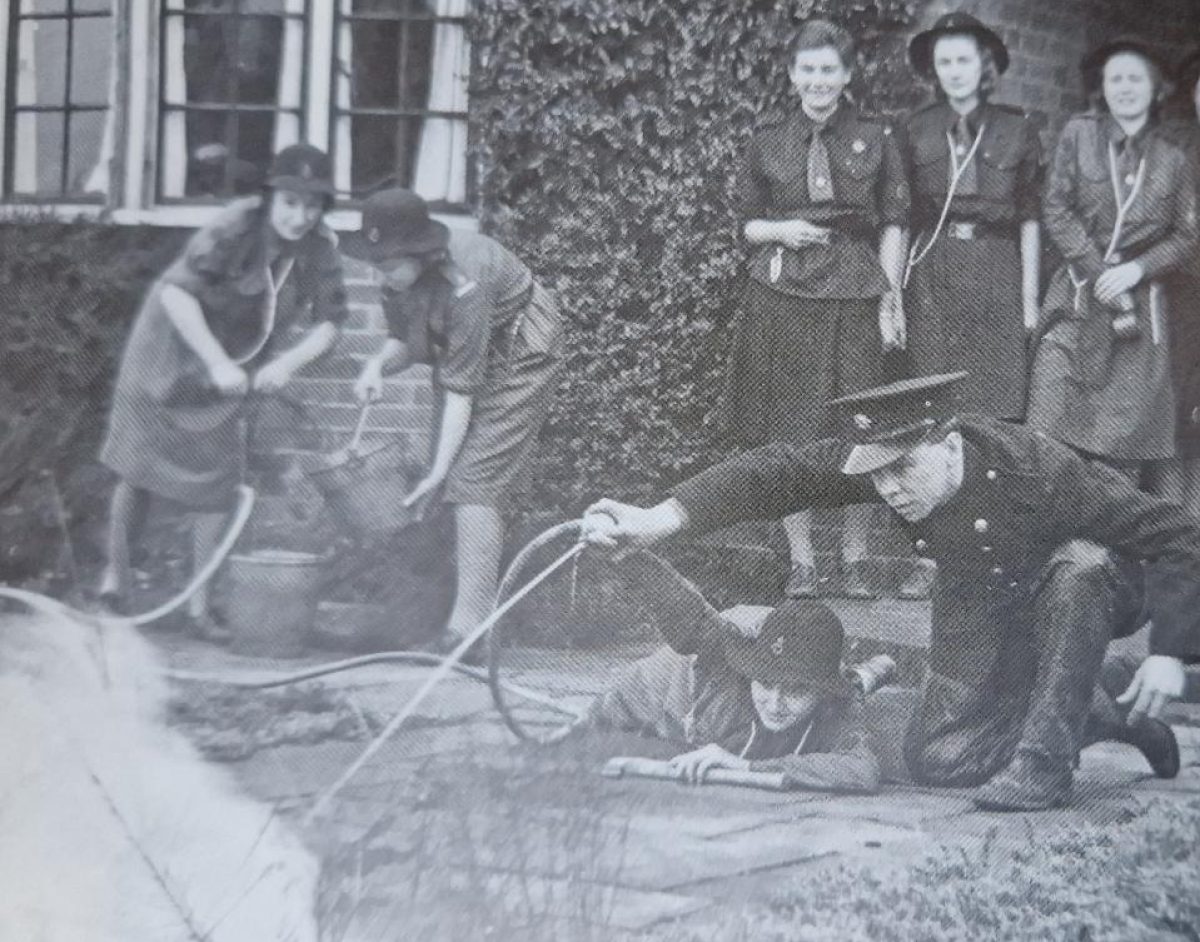
During the mid-war period, with the coming of the blitz, Guides were using their newly-learned practical skills. Using first aid to treat casualties, using stirrup pumps to put out fires, dealing with incendiary bombs, and working in bomb shelters to serve food and lead sing-songs to keep people occupied.
The same applied for Extension Guides – the branch of Guiding for Guides with disabilities. For Guides who were bed-bound the war was an especially worrying time as they could not go to air raid shelters, and instead had to stay where they were and take their chances. A 14 year old Extension Guide recounted an incident “The night we had the raid, my young sister and I had Mother for casualty number one. She bled profusely, and we were thoroughly glad of our combined first-aid knowledge. Emma did the running about, and I produced the equipment.” It must have been worrying for her to see her sole carer bleeding from a shrapnel wound, yet she was prepared with a first-aid kit, and level-headed enough in a crisis to be able to direct her younger sister in using it.

‘Golondrinas’ and Guiding in Europe
All this was happening in the UK, but what of Europe? Much of northern Europe wasn’t fully affected by war until the spring of 1940, as it was only then that the war came to have full effect with invasion happening to various countries in western Europe. Wherever countries were invaded, Guiding (and Scouting) were soon banned, with all children ordered to attend the government-approved youth organisation instead.
Some Guides, however, did escape from Europe during the early years – often utilising their Guiding skills. Whether by using stalking skills to evade capture when crossing heavily-guarded national borders, or using their knowledge of astronomy and navigation to guide small boats across the Channel, a number of girls managed to escape to Britain. In France, when many civilians were fleeing their homes ahead of the invasion, the Guides worked to provide first aid for those tramping the roads, and sought to reunite families split up in transit.
The result of this migration was a number of Guide refugees arriving in London from Poland, Belgium, Netherlands, France and many other countries. Many gathered at the new World Centre in London, Our Ark, to the extent that a pair of small rooms was set aside for them on the top floor, known as “Notre Foyer”. A term was also adopted for these refugee Guides – “Golondrinas”, meaning swallows – birds of passage who visit Britain to stay for a while, before in time returning home. In lives so totally disrupted, Guiding was both familiar, and a practical occupation. Some joined British units, but in other areas there were enough girls from a particular country in a locality to form a ‘unit in exile’, such as the Polish and Belgian Guide Companies in London, and the Company for German, Austrian and Danzig refugees, also based in London.
In 1940 there were also Guides newly evacuated from the Channel Islands prior to their invasion, and from Gibraltar, who arrived in the UK. They were welcomed into their new districts, and in the case of the Channel Islands Guides, some ‘Companies-in-exile’ continued.
Meantime in Europe, Guiding continued in secret. In Poland, with all schools closed down and Polish schoolbooks destroyed, Guides started running underground schools. Guides trained as decoders, and some helped escaping POWs – in one case two Poznan Guides who were helping POWs escape were caught near the Yugoslav border, and both were arrested – one was hanged and the other beheaded. Guides were involved in smuggling intelligence messages, distributing underground newspapers, and carrying out acts of sabotage.
International Donations
As well as the work done by Guides in Britain for others, they were also beneficiaries, or the conduit for donations from abroad. Donations of clothing were received from Australia, South Africa, New Zealand, Barbados, Gibraltar, India, Zimbabwe and the USA. Financial donations were also received from Australia, parts of Africa and the USA. The Girl Guides Relief Fund was started to assist Guides of all nationalities in the UK who might be suffering as a result of the war, including British Guides.

The founder’s death, the Chief Guide returns to Britain, and the B-P Memorial Fund
Through the late 1930s, the Chief Scout’s health had started to fail, and he had some bouts of serious ill-health. In 1938, his doctor recommended moving to a more favourable climate, where the 81-year-old could avoid the cold, damp English weather. At the same time an old Scouting acquaintance was building a hotel at Nyeri in Kenya, and thus the Baden-Powells arranged to have a chalet built on the site, and moved there, they thought temporarily. The other advantage was that at that time, all of their children were living in different parts of Africa, so they hoped family visits would be more straightforward.
The Baden-Powells were able to enjoy several years in Kenya, and Olave became involved in Guiding there, but in the last 6 months of his life especially, Robert was very ill with heart problems, being seriously ill in late 1940 before he passed in January 1941. He was buried in a ceremony carried out by the Kenyan Scouts, which Olave opted not to attend. Guiding launched a fund to create a memorial to him, with the funds being initially invested in National Savings for the war, with a view to the memorial being established when the war bonds became redeemable.
The B.-P. Memorial Fund was launched on 23rd April 1942. As “The Guider” magazine said, “Lord Baden-Powell, Chief Scout of all the World, gave to us, through Scouting and Guiding, the greatest and most successful adventure for youth that history has ever seen – an adventure in training, unique and thrilling – a way of service – a code of chivalry – which has lit a torch of comradeship through out the world. It is to perpetuate his memory for all time, to ensure that future generations of Guides shall know and revere his name as we do, that I am asking you to raise this fund now for a really fine memorial.” “What our memorial will be has not yet been decided, for it will require the most careful consideration, and we feel it is almost impossible to reach a decision until we have some clear indication of the sum likely to be raised. One think, however, I can promise you – that whatever form the memorial takes, it shall be something of lasting benefit to Guiding at home, in the Empire, and throughout the world.”
The initial target was £80,000, and it had been decided that initially, the monies raised would be lent to the Government through the National Savings scheme. Monthly targets were set to buy specific items of equipment for war use – the first target for 23 April to 24 May 1942 was to buy rubber dinghies for airmen – which depending on size cost £15, £35 or £40 each. As well as donations from around the UK, they also came in from Bermuda, British Virgin Islands, Burma, Fiji, Jamaica, Montserrat, Northern Rhodesia, Palestine, St Kitts, Tanganyika, BGIFC Belgium, Montevideo, Portugal, Egypt, and many more.
Olave stayed on in Kenya for a further year after Robert’s death, visiting family and tying up the loose ends of her life there, before opting to sail back to Britain in July 1942. But, in their absence, the Baden-Powells’ house in England had been requisitioned for use by the army, so she had no home to return to. As a result, she stayed at Guide Headquarters for a time, before being granted a ‘grace and favour’ apartment at Hampton Court Palace, which she lived in until 1976. During the war Olave worked in the UK to encourage Guiding there and in the other countries it was safe to communicate with – and as soon as it was possible in 1944, made a visit to Europe.
The BP memorial fundraising continued, often with monthly targets to aim at. The fourth and final target month, from 25th January to 22nd February 1943, was to raise funds for the army’s carrier pigeons, which were used to carry many important and confidential messages. In return, the Army Pigeon Service arranged for pigeons to fly from each Guiding County to deliver Thinking Day messages to the World Chief Guide at Headquarters in London, from around Britain. It so happened that the first pigeon to arrive had flown from the Chief’s home town of Chesterfield in Derbyshire.
Much of the fund was invested in War Bonds, the view taken being that the money should be invested for the benefit of the nation first, allowing time for decisions to be made about how best to commemorate Baden-Powell. (It went on to be used to fund the Girl Guide Homecraft Training Centre at Pax Hill which ran for a few years, and other training schemes). The opening of the GIS fund in October 1943 tended to supercede the memorial fund.

The Founder’s Final Messae to Guides
Robert Baden-Powell, some decades before his death, drafted a personal message for each for Scouts and for Guides, to be published after his passing. The one for Guides was published in “The Guide” magazine in January 1941:
“My dear Guides
This is just a farewell note to you, the last that you will receive from me. It is just to remind you when I have passed on that your business in life is to be happy and to make others happy. That sounds comfortable and easy, doesn’t it? You begin making other people happy by doing good turns to them. You need not worry about making yourselves happy, as you will very soon find that that comes by itself, when you make other people happy, it makes you happy too. Later on, when you have a home of your own by making it a bright and cheery one you will make your husband a happy man. If all homes were bright and cheery, there would be fewer public houses and the men would not want to go out to them but would stay at home. It may mean hard work for you, but will bring its own reward then, if you keep your children healthy and clean they will be happy. Happy children love their parents. There is nothing can give you greater joy than a loving child. I am sure God means us to be happy in this life. He has given us a world to live in that is full of beauties and wonders and He has given us not only eyes to see them but minds to understand them if we only have the sense to look at them in the light. We can enjoy bright sunshine and glorious views. We can see beauty in the flowers. We can watch with wonder how the seed produces the young plant which grows to a flower which in turn will replace other flowers as they die off. For, though plants, like people, die, their race does not die away but new ones are born and grow up to carry on The Creator’s plan. So, do you see, you women are the chosen servants of God in two ways; first, to carry on the race to bring children into the world to replace the men and women who pass away; secondly, to bring happiness into the world by making happy homes and by being yourselves good, cheery comrades for your husbands and children. That is where you as Guides especially come in. By being a ‘Comrade’, that is, by taking an interest in your husband’s work and aspirations, and so be a guide to him. Also, in bringing up your children, by strengthening and training their minds and characters as well as their bodies and health, you will be giving them to the better use and enjoyment of life. By giving out love and happiness in this way, you will gain for yourselves the return love of husband and children and there is nothing better in this world. You will find that Heaven is not the kind of happiness somewhere up in the skies after you are dead but right here in this world in your own home. So guide others to happiness and you will bring happiness to yourselves and by doing this you will be doing what God wants of you.
God be with you.
Baden-Powell”
 Leslie's Guide War History