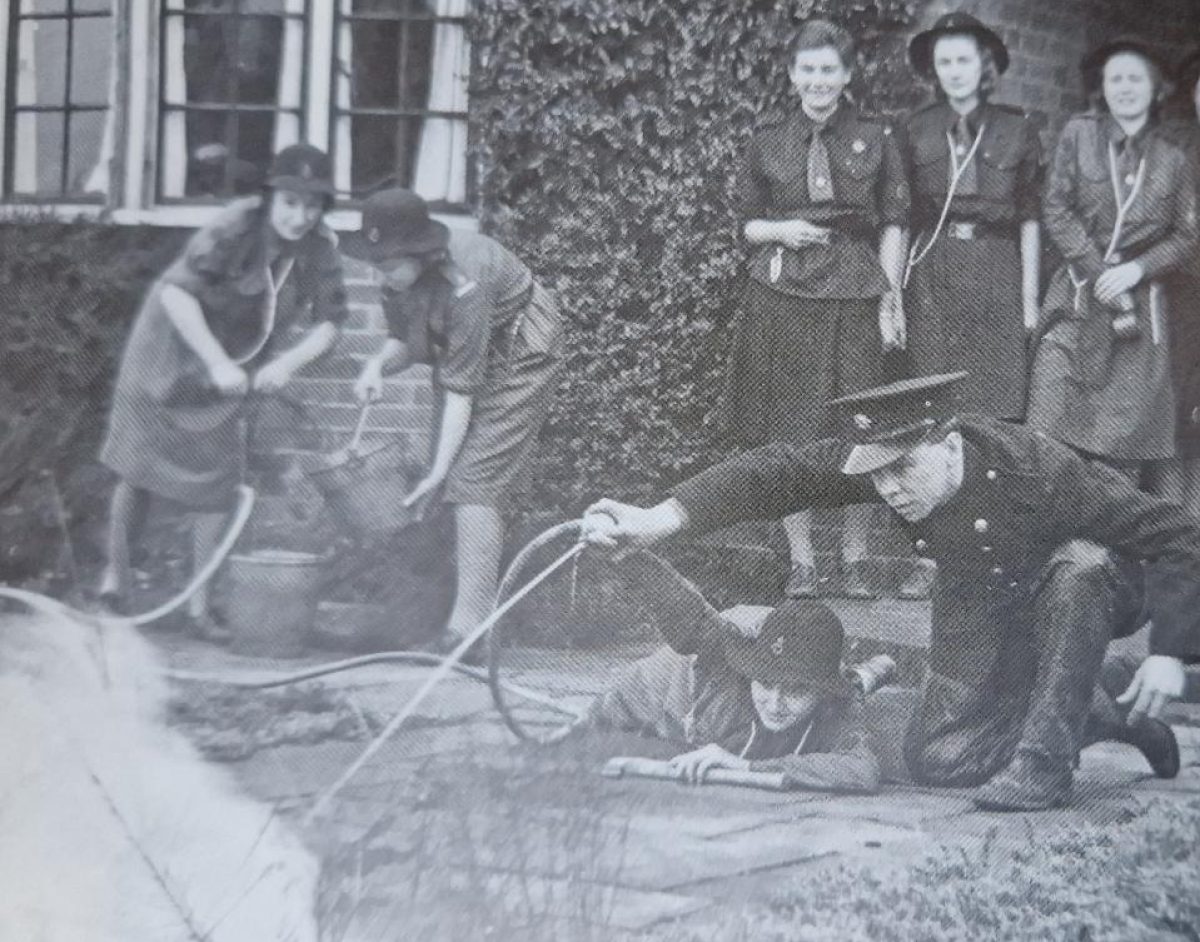

The coming of war brought fundamental changes to the Ranger section’s programme – and to the number of members. In 1939 Rangers was a section of two halves – Sea Rangers specialised in boating and nautical theory and practices alongside mainstream Ranger work. Land Rangers focused on outdoor activity on land (although they could occasionally take part in water activities too). Each section had it’s own uniform, and also it’s own programme of challenges and awards.
The Ranger uniform was similar to the Guide one – an overshirt (confusingly, called a jumper) in Guide blue, worn over the navy skirt, with a triangular scarf folded into a necktie, and the belt worn over the blouse. Rangers in this era had Patrols named after trees, and wore Patrol emblems on the left breast and Shoulder Knots in Patrol colours on the left shoulder. Their hat was of navy felt like the Guide one, but had a higher crown and broader brim.
For Land Rangers, the programme in 1939 consisted of
Ranger Test
1) Have passed the Guide Tenderfoot Test (A recruit may then be enrolled as a Guide if she wishes).
2) Know how Scouting and Guiding began and have read Scouting for Boys or Girl Guiding or The Story of the Girl Guides or three chapters from Story of a Million Girls (the chapter on her own country and two of her own choice). Know the World Flag and what it stands for.
3) Prove her ability to deal with two sudden unexpected occurrences such as are suggested by certain clauses of the following badge tests: Handywoman, Fire Brigade, Rescuer and Ability; and know how to arrest bleeding.
4) Follow a map for three miles in unknown country or cook a two-course meal out of doors. Know the Highway Code and be able to use a public telephone call box.
5) Understand the rules of health, and have taken twenty minutes exercise in the open air for thirty days, if possible, consecutively. (In exceptional circumstances, exercise near an open window may be substituted).
6) Have studied and understood the Promise and Law from the Ranger point of view, and prove herself dependable and steadfast of purpose by carrying out some definite undertaking for others.
Ranger Star
To gain her Star a Ranger must pass either in Section A (specialised) or in Section B (general) in each of the eight undermentioned groups. In at least three of these groups she must pass in Section A.
She must be a helpful member of the company and must prove that she is trying to use her knowledge in the service of others.
Section A
Group 1: Senior Cook Badge.
Group 2: Ambulance Badge (if under 16) or First Aider.
Group 3: Sick Nurse Badge (if under 16) or Probationer.
Group 4: Nurse or Public Health Badge
Group 5: Citizen, or World Citizen, or Empire Knowledge Badge (When the Citizen Badge is chosen, clause 2 in section B must also be taken, to ensure the acquisition of at least some knowledge of international Guiding.)
Group 6: Hiker, or Campcraft, or Explorer, or Pioneer, or Nature Lover Badge
Group 7: Needlewoman Badge (Senior or Junior).
Group 8: Book-Lover, or any Art and/or Craft Badge.
Section B
Group 1: Cook a two course meal and understand the storing of food.
Draw up a menu for a week in summer and winter, on a definite sum of money.
Group 2: Deal with fire accident, unconsciousness, shock and simple wounds.
Apply artificial respiration and understand the immediate measures to be taken in cases of accidents.
Group 3: Prepare a sickroom and make a bed with a patient in it.
Take a temperature.
Apply a finger bandage and a fomentation.
Show a knowledge of the administration of medicines.
Group 4: Know the best methods of feeding, dressing and bathing a baby of under a year.
Know the facilities in her area for advice and treatment in the case of expectant mothers, infants and young children, school children, children who are mentally or physically defective, cases of accident or illness.
Group 5: On a given route of about a mile, chosen by the candidate, direct a stranger to the town or village hall, fire and police stations, nearest post office, doctor, chemist (with hours of Sunday opening), garage, bus termini and railway station.
Know six Guide uniforms and six national flags of countries other than her own, and know something of the Guides and their life in one of these countries. Point out on a map six other countries where there are guides.
Know something of her own system of local government.
Group 6: Have spent at least half a day alone or with only one companion in the country, cooking her own food and observing the wild birds, animals, plants and flowers, and give a report of what she has observed; or (with permission of C.C.A.):
Organise and carry out an overnight hike with one or more companies.
Choose one of the following:
Know six constellations, six trees, six birds and ten flowers.
Swim 50 yards.
Visit four places of interest in the neighbourhood and know their history.
Signal and read simple messages in Morse at a distance of 150 yards.
Group 7: Make a garment (needlework).
Choose one of the following:
Convert a packing case into something useful for the home.
Use three knots (other than those in he Tenderfoot Test), splice a rope, and know two kinds of lashing.
Darn, mend, and remove stains from material.
Group 8: Do one of the following:
Read two books from Book-Lover Badge.
Perform five country dances.
Tell a story for not less than three minutes.
Teach something in the Company (e.g. handicraft or a game).
Make a scrap or log-book containing some original work.
Conduct a sing-song.

Sea Rangers wore a distinctive nautical-based uniform. There was a navy overblouse worn with a navy skirt, and a black tie. The had was also in navy, with a white cover worn in summer months. For boatwork there was also the option of a white top with navy trim. At this stage, Sea Rangers had the option of Patrols, and could work for Interest Badges (which were stitched in blue thread rather than the red thread of Land Ranger badges). Sea Rangers were also expected to make their own lanyards, using decorative knots, in white plater’s line.
For Sea Rangers in 1939, the programme was
Ranger Test
1) Have passed the Guide Tenderfoot Test (A recruit may then be enrolled as a Guide if she wishes).
2) Know how Scouting and Guiding began and have read Scouting for Boys or Girl Guiding or The Story of the Girl Guides or three chapters from Story of a Million Girls (the chapter on her own country and two of her own choice). Know the World Flag and what it stands for.
3) Prove her ability to deal with two sudden unexpected occurrences such as are suggested by certain clauses of the following badge tests: Handywoman, Fire Brigade, Rescuer and Ability; and know how to arrest bleeding.
4) Follow a map for three miles in unknown country or cook a two-course meal out of doors. Know the Highway Code and be able to use a public telephone call box.
5) Understand the rules of health, and have taken twenty minutes exercise in the open air for thirty days, if possible, consecutively. (In exceptional circumstances, exercise near an open window may be substituted).
6) Have studied and understood the Promise and Law from the Ranger point of view, and prove herself dependable and steadfast of purpose by carrying out some definite undertaking for others.
7) Swim 50 yards.
At the same time as working on this test, the Sea Ranger may start work for Able Sea Ranger Test.
Able Sea Ranger Test
I Intelligence
1) Signal and read simple message in semaphore.
2) Read a nautical book.
3) Know and describe intelligently:
a) Six cargoes, from where they come and for what they are used; or
b) The rig of six ships or boats; or six types of craft such as fishing boats, trawlers, whalers, lightships, lifeboats, dredgers, salvage-ships, etc.; or
c) Six fish and their habits, and how they are caught; or
d) Six water birds and their nesting-places; or
e) Six seaweeds and where they grow; or
f) Six constellations and how to find your direction by three of them.
II Handicraft
1) Use seven knots, splice a rope and do one of the following:
Make a lanyard, using at least eight fancy knots (to include plaits and twists and a Turk’s head); or
Make and sling a hammock;
Embroider or applique patrol emblems, or knit a Sea Ranger jersey.
III Health
1) Swim 25 yards.
2) Dance a hornpipe or perform five folk dances.
IV Service
1) Show how to carry a sick or injured person; how to enter a smoke-filled room and rescue its inmates; deal with the apparently drowned and asphyxiation through smoke or gas poisoning.
2) Do one of the following:
Conduct a team game.
Tell a sea story for not less than three minutes.
Make a scrap or log book, containing some original work.
Lead three sea shanties.
Sea Service Test
To gain her Sea Service Test, a Sea Ranger must pass in the four following Sea subjects, and either in Section A (specialized) or in Section B (general) in each of the eight undermentioned groups. She must be a helpful member of the crew, and must prove that she is trying to use her knowledge in the service of others.
Sea subjects (compulsory).
1) Able Sea Ranger Test.
2) Swimmer or Life Saver.
3) Boatswain.
4) Be able to:
a) Recognise various types of craft, and the distinguishing marks of the ranks and ratings of the Royal Navy.
b) Do simple carpentering, making two articles useful for camp, home or company.
c) Make a flag of bunting, or garment, or mend a tent or sail.
Section A
Group 1: Senior Cook
Group 2: First Aider; or Ambulance.
Group 3: Probationer; or Sick Nurse.
Group 4: Nurse; or Public Health.
Group 5: Citizen; or World Citizen; or Empire Knowledge Badge. (When the Citizen Badge is chosen, clause 2 in section B must also be taken, to ensure the acquisition of at least some knowledge of international Guiding.)
Group 6: Athlete; or Campcraft; or Explorer; or Water Naturalist.
Group 7: Astronomer; or Decoder; or Signalling Transmitter.
Section B
Group 1: Cook a two-course meal and understand the storing of food. Draw up a menu for a week in simmer and winter on a definite sum of money.
Group 2: Deal with fire accident, unconsciousness, shock, and simple wounds.
Group 3: Show how to prepare a sick room and make a bed with a patient in it. Take a temperature. Show a knowledge of the administration of medicines. Apply a finger bandage and a fomentation. Now the notifiable infectious diseases and the precautions to be taken to prevent he spread of infection.
Group 4: Know the best methods of feeding and bathing a baby of under a year. Know the facilities in her area for advice and treatment in the case of expectant mothers, infants and young children, school children, children who are mentally or physically defective, cases of accident or illness.
Group 5: On a given route of about a mile, chosen by the candidate, direct a stranger to the town or village hall, fire and police stations, nearest post office, doctor, chemist (with hours of Sunday opening), garage, bus termini and railway station.
Know six Guide uniforms and six national flags of countries other than her own, and know something of the guides and their life in one of these countries. Point out on a map six other countries where there are guides.
Know something of her own system of local government.
Group 6: Have spend at least half a day alone or with one companion, by sea, river or lake, observing the wild birds, aquatic creatures and plants and give a report of what she has observed.
Choose either of the following:
Visit four places of interest in the neighbourhood and now their history.
or
Visit a boat-builder’s yard, or a dockyard or harbor, and describe your visit.
Group 7: Keep a weather chart for thirty days. Know the storm and distress signals by night and day.
or
Know the days and time of mail departures by land, sea and air, and the approximate time in transit to different parts of the world. Be able to find the time in any part of the world by Greenwich Mean Time.
Group 8: Make a model or drawing of an incident in the history of seafaring, or write an essay on such an incident.
or
Know the international code flags and the use of the International Code Book.
or
Know the rule of the road at sea, and the principal imports and exports of the British Isles.

Ranger Proficiency Badges
In addition, Rangers and Sea Rangers could work for the Ranger Interest Badges: Ability, Airwoman, Architect and Town Planner, Art Lover, Arts and Crafts, Astronomer, Authoress, Beauty Lover, Bell Ringer, Bookbinder, Braille, Campcraft, Choral Patrol Badge, Citizen, Current Events, Dairymaid, Decoder, Dressmaker, Economist, Electrician, Embroideress, Empire Knowledge, Explorer, Farmer, Figure Skater, Finisher, First Aider, First Class Cook, First Class Knitter, Folk Dancer, Geologist, History Student, Horticulturist, Housecraft, Housekeeper, House Surveyor, Interpreter to the Deaf, Leatherworker, Linguist, Local Knowledge, Mariner, Motorist, Musician, Nature Lover, Nurse, Physical Training, Printer, Probationer, Public Health, Reader, Rescuer, Samaritan, Sea Lore, Secretary, Senior Athlete, Signalling Transmitter, Stagecraft, Surveyor, Textile Worker, Toycraft, Water Naturalist, World Citizen.
The Badges were embroidered in red thread for Land Rangers, and in blue thread for Sea Rangers, who were especially encouraged to take badges in subjects of nautical relevance.
By early 1942, the Ranger programme was changed. The Government education departments were now keen to arrange training for the 16-18 age group, as pre-service training, mobilising all available resources. Girls registered in March and April 1942 – those not attending school full time and not already connected with a youth organisation offering opportunities for training and service were to be invited for interviews. The new Ranger Home Emergency Service provided that training, which would help prepare the girls for war service when their time came, whether that was in the women’s services, in industry, or in voluntary service.
Home Emergency Training scheme
“Home Emergency Training
Why Home?
One of our aims in winning this war is to make the future safe for ‘homes’ and families, and we want to train our Rangers to look forward to homes, to the finding of the right partner, and learning all that is fundamental to living in a home. It is a woman’s purpose in life to make a home – she cannot help doing it!
Why Emergency?
We want to teach our Rangers that Rangering is not a thing which happens once a week. It is a weapon with which to outwit the invader, a first-aid case with which to repair destruction, and a hypodermic syringe with which to inject strength and courage to oneself and one’s friends and neighbours in times of emergency.
Why Service?
The Ranger must be taught from the moment she joins the Guide Movement that she forms part of a gigantic chain. If any of the links become weak the whole chain may break. The means of keeping it securely attached to the remainder of the chain is esprit de corps – pride in one’s own Movement, the traditions behind it and what she can do for its future.”

War brought changes for both sections with the introduction of the Home Emergency Service programme.
Now the Pre-enrolment test was:
1) Pass the Guide Tenderfoot Test (a recruit may then be enrolled as a Guide if she wishes).
2) Study the Law and Promise from a Ranger point of view.
3) Know the Guide World Flag and what it stands for.
4) Attend H.E.S. training regularly for three months.
(Additional for Sea Rangers – Swim 50 yards).
Only once a Ranger had gained the H.E.S. Armlet (or worked at the basic training for a year) could she specialise by working for the Ranger Certificates, which replaced the Interest Badges, for up to three years. The Certificates were:
1) Home Service – Cook and Caterer, Dressmaker, Electrician, Finisher, Handywoman, Housecraft.
2) Nursing Service – First Aid, Home Nursing, Hygiene, Samaritan.
3) Child Welfare – Child Study, Infant and Child Welfare, Play Leadership.
4) Cultural – Art, Drama, Folk Dancer, Handwork, Literature, Music.
5) Coast and River Service – Coast and River Service, Life-Saver, Mariner, Sea Lore, Seamanship.
6) Outdoor – Astronomer, Campcraft, Explorer, Forestry, Landgirl, Local Knowledge, Naturalist, Rifle Shot, Water Naturalist.
7) Community Service – Airwoman, Citizen, Civil Defence, Emergency Cook, Mechanic, Public Health, Signalling Transmitter.
8) World Citizenship – Empire Knowledge, International Knowledge, Linguist.

A poster was produced, to use for training which detailed the Home Emergency Service Pre-Service Training Scheme:
Home Emergency Service
The following basic training is taken in conjunction with the Pre-Enrolment Test, and for Sea Rangers the A.B. Test.
Discipline
A high standard is very important. Quick response to orders and absolute reliability are essential in times of crisis. Regular drill should be included. Regular attendance will be expected. Uniform must be worn correctly and all clothing kept mended and in good order, ready for any emergency. Punctuality and general reliability will be tested over a period of at least six months, and each Ranger must keep a detailed daily record for two weeks or longer, until an unbroken record for a whole week can be produced.
Fitness
A Ranger cannot give her best service unless she is fit and well. To keep herself so is her personal responsibility. She should:
1) Take at least half-an-hour’s outdoor exercise every day, unless ill.
2) Know the rules of health and undertake to apply them in everyday life, with the definite aim of raising her own standard of fitness.
Messenger Work
Communications must always be kept open, and a Ranger should be trained and ready to help in this service. She should be able to:
1) Memorise a message of twenty words, including names, figures and addresses, and deliver it correctly after covering a mile at Scout’s Pace – even if she has met with frequent interruptions on the way.
2) Give and receive messages accurately over the telephone (This may be omitted only if there are no telephones in the neighbourhood).
3) Write down verbal instructions briefly, clearly and accurately.
4) Show thorough knowledge of the Highway Code.
5) Send and read in Morse or Semaphore at a speed of fifteen letters a minute.
6) Find her way about by day or night, showing intimate knowledge of the neighbourhood, and understand practical use of map and compass (thirty-two points of compass to be learnt).
Emergency Training
When an accident happens it is important that a Ranger should keep her head, but it is equally important that she should know the right thing to do. She should know the right way of dealing with the following:
1) Outbreak of fire, including use of stirrup pump/
2) Severe bleeding.
3) Gas attack, including use and care of respirators.
4) Suffocation.
5) Shock, including ability to light a fire out-of-doors and produce a hot stimulant in not more than twenty minutes.
6) Electrical breakdown, requiring repair of fuse wire; and the assembling of an electric buzzer so that it can be used.
HES Games and Practices (from The Guider, July 1943)
Find Your Partner
The Company is divided into two teams and the members of one team have electric torches. The other team write their names on separate pieces of paper. These papers are then jumbled and given out to the signalling team. If the numbers are not equal, each signaller may be given more than one paper. When the lights go out, the signallers flash the names they hold, while the rest try to find out who is signalling their own name. The first to claim her own partner from the signalling team and bring her to Captain wins.
Electrical Repairs
Flashlight – each Patrol is given the parts for assembling a lamp, and the lights are put out. The first Patrol to flash S.O.S. with the completed lamp wins. This may also be played with buzzers if enough are available.
On The Spot
Each couple is given a map of the district and a packet of flags (on pins). The flags have written on them “Fire Station”, “First Aid Post”, etc., and each couple tries to place them on the map correctly in the least possible time. If desired, they may be asked to place the flags on the fire station, etc., nearest to some given point, e.g., Company HQ.
Brains Trust
Let the Company elect a ‘Brains Trust’ from its own members, and tell the rest to bring questions on ‘Health and Beauty’ next week. Questions are written on slips of paper and drawn out of a hat. Captain may put the questions and sum up the answers given.
Treasure Hunt
If the Company can have the run of a blacked-out building, an exciting treasure hunt can be arranged. The first clue may consist of map references, the initial letters of the villages thus found on the map forming a word. Before the hunt commences each Ranger hangs a scarf through her belt. If a member of another Patrol can seize this, she uses it to put a sling on the right arm of its owner, who is then less useful to her Patrol. Clues are read by the light of torches.

There were also practical changes to the uniform, to allow for both the increasing numbers of girls joining Rangers due to the lowering of the age limit for joining from 16 to 14, and the pre-service training it offered, improving the chances of being accepted for the women’s forces when conscription time came – and to provide a uniform which was more economical in terms of clothing coupons than what had gone before. Indeed, it’s said that some Rangers used darning wool to knit their jumpers, joining the short lengths together, rather than balls of knitting wool.
So in the early years of the war, the uniform was:
Land Rangers
Uniform dress – Headquarters blue, official pattern
Hat – Navy blue waterproof drill
Hat badge – Navy blue cloth, with official stamp embroidered in red
Tie – Striped or plain colour, open end or triangular
Shoes and stockings – Black or brown (leaf mould), whole company to wear same colour; stockings to match shoes
Badge – Tenderfoot badge of red enamel.
Sea Rangers
Uniform dress – Headquarters blue, official pattern
or Jersey – Navy blue
White jumper – Flannel for winter, drill for summer, may be worn underneath jersey, with small portion showing at neck; not more than three inches from base of neck downwards. For unceremonial occasions may be worn tucked into a navy blue skirt with navy blue blazer, in addition to the official belt and hat. Tenderfoot badge worn in centre, two inches below neck line.
Tie – Black, triangular, folded in narrow fold bandage, ends tied under collar at back; no sailor’s knot in front, and held in position by badge and by small bow of navy braid tied 2in. from the bottom of tie. braid to be 27 in. long and 3/4 in. wide.
Cap – Blue waterproof drill, with white pique cap cover from May 1st to September 30th.
Tally Band – Black with “Sea Rangers” in gold on it.
Tenderfoot Badge – Blue enamel
Knife – On white lanyard worn round the neck and attached to belt on right side.
Whereas by the middle of the war:
Rangers:
Skirt – Navy blue
Jersey – Grey knitted (with long sleeves) worn outside the skirt.
or (for summer wear) Shirt – Grey cotton or flannel
Tie – Navy blue triangular, worn scarf-wise, with point at back of neck and County Badge sewn above the point. First-Class Guides may wear their Badge sewn above the County Badge.
Woggle – Red – may be made of cord, leather, string, wood etc.
Belt – Brown leather, with official buckle
Hat – Navy blue beret
Hat Badge – Red embroidered trefoil, worn above left eye.
Tenderfoot Badge – Red enamel
Stockings – Brown (leaf mould)
Socks – Colour of jersey or shoes
Shoes – Brown. (Black shoes and stockings may be worn, but the whole company must wear the same).
Lanyard – White, for Patrol Leader or Second, worn under the point of the scarf and fastened to the belt.
Service Star – One star denoting number of years’ service in the Movement, worn on the belt on the right side of the buckle.
Sea Rangers
Skirt – Navy blue
Jersey – Navy blue
or (for summer wear) Shirt – White cotton or flannel
Tie – Black triangular, worn scarf-wise, with point at back of neck.
Woggle – Royal blue
Hat – Sea Ranger hat, or, when this is unobtainable, a navy blue beret
Tally Band or Hat Badge – On the Sea Ranger hat a black tally band, with “Sea Rangers” in gold letters, or blue embroidered trefoil in centre front. On the beret a blue embroidered trefoil is worn above the left eye
Tenderfoot Badge – Blue enamel
Belt – Brown leather, with official buckle. Service Star worn on right of buckle.
Knife – Worn on white lanyard, and attached to belt on right side
Stockings – Brown (leaf mould)
Socks – Brown, or to match jersey or shirt
Shoes – Brown, or for boat work, white canvas.
 Leslie's Guide War History