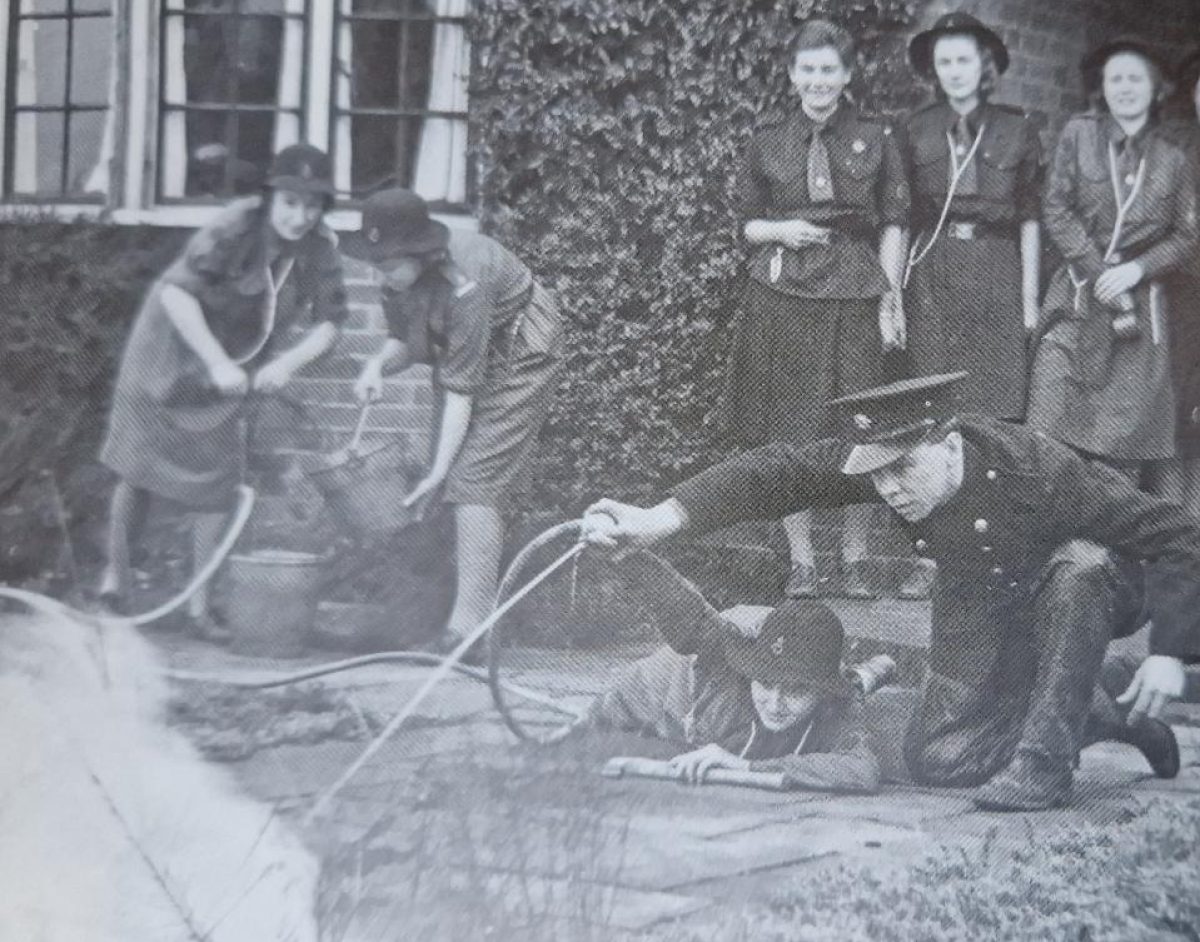

Guiding had been started in 1910, in a sense by the girls themselves, and unusually, as an independent, standalone organisation entirely separate from the Boy Scouts. Thanks to Agnes Baden-Powell’s hard work in touring the UK to promote the organisation, and the work of the efficient organising committee she led, by 1914 Guiding was established across the UK, and it’s structure developed. By this time the first handbook had been published, and a monthly magazine had been established to communicate information to the members. Other affiliated groups such as the Girls’ Friendly Society and the YWCA had started Guiding units too. Headquarters was established with a shop, and a section for younger girls, Rosebuds, was just starting.
But during the summer of 1914, tension was growing in Europe, and a series of treaties which had been agreed between different countries over a number of years meant that, if any war broke out between any two countries in Europe, many other countries would be obliged to join in with the dispute on one side or the other. Thus, when trouble did break out in Sarajevo, Belgium, France and Britain were all drawn into what would become World War 1.

Guiding in 1914 – Guides
By 1914 Guiding had spread across the UK, despite still not being approved of by all – some adults remained concerned about tomboyishness and neglect of household duties. It was, after all, an era where the place of girls and women were clearly laid out, and very different from the roles which boys and men fulfilled. As such, Agnes Baden-Powell had had to tread carefully when adapting “Scouting for Boys” into the Handbook for Girl Guides, in order to find ways of retaining as many as possible of the activities which had attracted the early Girl Scouts, but presenting them in ways which would win the approval of wary parents. As such, the handbook had retained the tracking in the form of recovering the sick for nursing, and first aid as sick nursing the wounded. The introduction of the book focused on the Girl Guide doing preparation and training to serve her country domestically should trouble arise.
Thus it isn’t surprising that, when war broke out in 1914, the early suggestions which were given for Guides’ war service – cheering up those heading off to serve, visiting those who were anxious, minding babies and young children, doing laundry or mending, obeying requests promptly, and perhaps assisting with dish-washing, cookery, sewing, knitting, collecting books and magazines, and gardening to generate produce for the kitchen – were not the sorts of exciting war service the Guides had hoped to be tasked with, especially when the Boy Scouts were being called on to literally protect the nation, by acting as coastguards and by guarding bridges and railway lines in case of enemy attack. Meantime Guiders were advised to offer their Companies’ services to the local Red Cross, St John’s Ambulance, Relief Committee, Soup Kitchen, Creche, Soldiers and Sailors Help Society, Hospital, local people in distress, or working mothers. But there was also a clear and specific warning – “Captains are asked to exercise special caution in the selection of girls for any public work. Every safeguard must be given to girls, even more now than in times of peace. Only those who bring a written permission from their parents should be employed. Every girl selected for work must have a card with her name and address, stating the work for which she is sent, and each card must be signed by the Captain.”

Guiding in 1914 – Brownies
Rosebuds were started in July 1914, just before WW1 broke out, and as a result were by no means widespread in the early years of the war. By 1915 the name was altered to Brownies, that name being deemed less soppy and twee. At this stage, however, the number of Brownie units which had been set up was small – far fewer than for Guide units – as such, it took time for the section to be developed, and so their scope for becoming involved in war work was limited – nevertheless, they did do their share of activities such as knitting, sewing, housework and gardening.

Practical War Work done by Guide Companies
In ‘The Girl Guide Gazette’ reports of August and September 1914, reports of early Company war work were published. These included collecting hospital supplies by trek cart, delivering messages, sewing, preparing a Rest Station Hospital, helping to train farmworkers in stretcher work, helping the postmistress, sewing for the red cross, making roller and triangular bandages, fomentations, wringers and flannel bandages, making and padding splints, filling sandbags, running a hospital’s linen room, equipping a field hospital, working as messengers, working in laundry, doing needlework, acting as messengers for the V.A.D. and Relief Committees, helping in hospitals, helping mothers who were going out to work, darning socks for the Territorial army, making aprons and caps for nurses, working with the Soldiers and Sailors’ Help Society, making slippers, socks and night shirts for the Red Cross and St John Ambulance Association, harvest work, setting up a Company relief fund, undertaking the domestic work of a convalescent home, giving first aid classes and nursing lectures, joining the V.A.D. and Red Cross, doing the cooking and needlework at an orphanage, fitting up the clubroom as a hospital and practising sick nursing and invalid cookery, acting as telegraph messengers, washing and rolling all the bandages in the Red Cross Hospital daily.
In addition, many older Guides took up war work – working on farms and as gardeners, or in war factories. At the same time, new Guide companies were established in some of the munitions factories which were being opened up around the country to supply the army with missiles, often amongst girls who had no previous experience of being Guides.

Practical War Work done by Rosebuds/Brownies
The work done by Rosebuds and Brownies tended to be more domestic in scale than that of the Guides – helping to tend the garden or family allotment in order to produce more vegetables and fruit for the table, helping look after domestic livestock, helping with housework, doing domestic knitting and sewing, helping to look after younger siblings. But they were also involved in making toys for children from poorer areas, and raising funds for war charities. Often, the work they did at home helped to free their older siblings and parents to do more war work outwith the home.

Charity Appeals supported by Guides
In the early part of the war, the focus was on fundraising efforts, with proceeds going to support groups such as Belgian refugees – this often took the form of concerts or sales of work – in some cases, the Companies in a locality supported a specific refugee. In addition, some Guides were involved in making bandages for hospitals, and collecting eggs or fresh fruit or vegetables for hospitals or for the army. (In these pre-NHS days most hospitals were charities wholly dependent on donations to cover running costs). Clothes were also knitted or sewn for Queen Mary’s appeal, and for local appeals such as that by the Mayoress of Winchester. Making scrapbooks or dressed dolls as Christmas presents for children in distressed areas was also common. Fruit was collected and made into jam, and rosehips for syrup. Funds were raised for the National Relief Fund, The Queen’s Work for Women Fund, and also for funds organised by individual newspapers, such as the Evening News Guides were encouraged to collect books and magazines which could be sent to the front for soldiers who were resting or recuperating behind the front line. Instructions were given for making hessian sandbags to be sent to the front, and the collection of Sphagnum moss for wound dressings was encouraged as a holiday activity.
Guides were specifically asked to produce knitwear for Scouts – during WW1 the Scouts were called on to serve as coastguards, and the long hours spent, often outdoors, scanning the horizon in case of enemy invasion, meant that they were in need of warm clothes.
In 1915 it was made clear that Guides were forbidden from taking part in any street collections of money for charity in uniform. At that time, Guiding was strictly of the view that money should be earned, and not begged for.

Mid-war
By January 1915, following the first air raids by Zeppelin airship on Scarborough, Lord Baden-Powell advised Guides to set up their headquarters as hospitals to deal with any casualties in their area. They were to both brush up their first and and sick nursing, and also set up the beds, linen and supplies needed to run a temporary hospital, and then offer their premises and services to the authorities.
Guides were also encouraged to volunteer work to work on farms, doing weeding, fruit picking, and harvesting.

War Service Badge
The War Service Badge was introduced in May 1915, and the clauses initially were to do:
A) Not fewer than 21 days’ special service for Hospitals, Nursing Institutions, and other Public Departments or Societies, or Girl Guides Hostels. This service must be at the request of some competent authority, and must be carried out for at least three hours per day, OR
B) Not fewer than 15 articles personally made, to include 4 pairs of socks, 4 pairs of mittens, 2 shirts, 1 pyjama suit, 1 child’s garment, 1 women’s garment, 1 belt, and 1 bed jacket. Knitting and needlework already done for Sailors, Soldiers, Sea Scouts, Belgian Refugees, Hospitals etc., may count. N.B. where it is not possible to have material for shirts, pyjamas and bed jackets provided, a Guide may make up her number of articles by adding to the number of socks and children’s garments. OR
C) For twenty-one day’s work, not necessarily consecutive, for paid employment in connection with recognised firms working directly for the Government in connection with the war, or in connection with “War Service for Women” initiated by the Government Labour Exchanges. In such work, for instance, as Farm Work, Dairy Work, Market Gardening, Poultry Farming, Light Machining for Armaments, Clothing Machining, Brush Making, etc., etc.

The Nurse Cavell Badge
It was late in 1915 that Nurse Edith Cavell was killed. From Norfolk, she was working in the Western Front, nursing soldiers from both sides alike.
1921 POR stated:
“To obtain the Nurse Cavell Badge a Guide must have shown either special pluck in saving life, self-sacrifice in work for others, endurance of suffering, or calmness in danger. These attributes would serve on the merits of the case as equivalent to some of the following tests:
For Guides – Ambulance, Sick Nurse, Cook, Laundress, Needlewoman, Scribe, Signaller, Housekeeper, Pioneer, Child Nurse or Interpreter, Carpenter, Handywoman.
For Senior Guides – First Aid, Probationer, First Class Cook, Finisher, Dressmaker, Clerk, First Class Signaller, Housekeeper, Pioneer, Child Nurse or Interpreter, Carpenter, Handywoman.
The personal character of the Guide as testified to by the Captain, or ascertained by the Headquarters Committee, will be an important factor in the awarding of this Badge, and a recommendation from the employer or school authorities as to punctuality, energy in work, and steadfastness of purpose, will also be required. Applications will be considered by a Special Committee at Headquarters.”

Senior Guides
Senior Guides were formed in 1917, to cater for Guides aged over 16. From the start, there were twin aims for the new section. The first was to provide a form of ‘finishing school’ for girls who had been in Guides for several years and mastered all the skills covered by the Second and First Class tests. The idea was to give a focus on taking those skills out to use them to serve in the wider community. The second aim was to provide a more suitable starting point for girls of 16 or more who were joining Guiding for the first time, amongst their peers, rather than have them learning the Guide tenderfoot test with the 11-year-olds. Initially, Senior Guides often belonged to Patrols attached to existing Guide units, it only being later that independent Ranger units became more common. As such, war work ascribed to Guides in accounts of the time can also be considered to potentially include work done by Senior Guides.

Guides and the Intelligence Service
At the start of the war, the Government’s Military Intelligence headquarters had employed Boy Scouts as confidential messengers. But – this did not work out as they had hoped, as during periods of inactivity the Scouts had tended to get into mischief. In September 1915, Military Intelligence tried replacing the Scouts with Guides, aged between 14 and 16. Each Guide had to sign a contract confirming parental permission and Guider recommendation, and pledging not to read any papers carried.
Their main role was as paid messengers distributing highly classified information. The teenagers were so trusted by MI5, that they were allowed to relay some of the messages verbally. They worked at Waterloo House and two other offices in central London, where they were divided up into Patrols of five or six Guides under a patrol leader. Section H5 in the document states: “Each is allotted to a floor and the patrol leader is responsible for the work, discipline and good behaviour of her patrol.
“The Guides are allotted marks each day by their patrol leaders and at the end of the month the room which has proved most generally satisfactory is awarded the prize picture for the following month.”
Section H6 adds, “A messenger should be between the ages of 14 and 16, a Guide of good standing, quick, cheerful and willing. Guides are engaged on three months’ probation. The initial rate of pay is ten shillings a week (50p) with dinner and tea included. Guides who do special work, or who have special responsibilities, receive a higher rate of pay. Those who help in the kitchen receive four shillings and sixpence (22½p) extra duty pay per month. The guides are paid weekly by the Captain on Friday morning. The hours of work are from 9am to 6pm and 10am to 7pm on alternate weeks. Fifty minutes are allowed them for dinner and 20 minutes for tea. Girl Guides are on duty on alternate Sundays and they get one half-day off duty each week. A week’s holiday is given in the summer and short leave at Christmas and Easter. When a Guide falls sick, a doctor’s certificate must be sent within 48 hours of the illness. Otherwise, all pay is stopped.
The Guides are responsible for dusting all rooms on their floors between 9am and 10am, cleaning and filling the ink pots and disinfecting the telephones, as well as answering any bells which may ring between those hours. After 10am their work consists chiefly of collections for the despatch room, for the posts, and for running messages, sorting cards, collecting files, collecting waste paper and rolling it up ready for burning.”
A total of 90 Guides worked for MI5 during the course of the war. The Guides had to observe a strict dress code which laid down that they work in full uniform, and their uniform blue skirts must be no more than eight inches off the ground. They had to wear a Guide belt and their distinctive hats at all times.

Guides at the Versailles Peace Conference
Such was the reputation for honesty and reliability that the Girl Guides built up during their service for Military Intelligence, that the Foreign Office arranged for a contingent of London Girl Guides from several Companies to go to the Paris Peace Conference, held at Versailles from June 1919, to run all the confidential errands for the British delegation. New uniforms were supplied to the chosen group, and two weeks of training given before they headed to Paris in early December. The team worked in shifts between 8 am and midnight, but were able to do some sightseeing in their down-time.
Some of them were invited to witness the signing of the peace treaty on 28th June but there was still work to be done on the details of the treaty, so they did not return to the UK until October 1919, ten months after they had set out.

The Guide Victory Rally
To commemorate the end of the war, a great ‘Victory Rally’ was organised at the Albert Hall in London (now the Royal Albert Hall) on 4th November 1919 – almost a year after the armistice had been signed, and allowing enough time for it to be clear that the ‘temporary ceasefire’ was going to hold. The rally was attended by some 13,000 Guides from across the UK and beyond, one of the largest gatherings of Guides to date. In order to have as wide a representation as possible, each Guide Company was invited to send Patrol Leaders, or two Guides, with one Guider. One Brown Owl and one Sixer per Pack were also invited. Guide Companies were invited to bring their flag, to be carried by one of their representatives, and County Flags were also welcomed. Hospitality was offered to those travelling from outwith London, and the event took the form of a service of thanksgiving, with hymns, prayers, addresses by the Chief Guide, Chief Scout and Miss Maud Royden, and the singing of the “Girl Guide Song” and the “Song of the Flag”.
 Leslie's Guide War History